Monday, March 19, 2007

Reconciliation and Haneke's form

I have been busy revising of the short scripts, Reconciliation. This is the short in which I am borrowing Haneke's form, from 71 Fragments, of one or more shots or fragments(some short, some long), which are then closed by a cut to black.
I am just realising the limitations of the form for a short. In 71 Fragments, Haneke as a number of character sets that he alternates with. This means that he can easily create texture and rhythm by moving from one set of fragments to another. In each fragment he has another set of characters, a different location, and potentially a different pace.
Because I want to keep the focus sharp I am sticking to one location, which means I feel there is no place to go. I just had a scene in the kitchen - what now? I have already been in the living room, kitchen, bedroom, bathroom, even the the closet!
In a feature this is not a problem.
I know, I know, I suppose I was really asking for it, taking this on.

I have now revised the script three times. Where is it going, despite my problems with pace and texture?
One addition I made, in part to defuse the drama, but also to make the story more focused, was to make it clear near the beginning that this is the day he is planning to move out. It was important that the audience is not left wondering what the events of the day are about, or how they will resolve themselves dramatically (it is clear in the title afterall).
I have already posted previously about how I have explored surface-reality in the story - packing, emptying a closet, vacuuming, doing the dishes. But my worry was that I also presented the couples estrangement in these everyday scenes - waking together (or rather not) in the morning. That these parts are not surface-reality, and may become drama.
I am now less worried about this. I might rationalise these elements as what Schrader calls disparity, the second element in the transcendental style (which leads to decisive action). I am happy with the story and I suppose the irony of the title, and how the reconciliation happens, in the mundane - he takes out the trash. I was most interested in how our lives are truly lived in these kinds of events.
Finally there is Schrader's final element, the transcendent:
3. Stasis: a frozen view of life which does not resolve the disparity but transcends it.
From the reconciliation - he, taking out the trash - to the macro view of the world, London at dusk, with lights coming on in flats just like this one.
The final codas of Ozu's films are reaffirmations of nature; they are the final silence and emptiness.
This is the first time we have left the flat, and looked at the world beyond the couple and their flat.

Friday, March 09, 2007

Sophie's and Paul's world

A week ago I was in Canary Wharf scouting for locations for Sophie and Paul's flat and the surrounding area, in Part 1. These are from the area to the east of Canary Wharf itself, East India Dock.
I tried to capture the sense of the place, but I don't think I was successful.
What is exciting about the place is a particular building, which can feel powerful and muscular, even if it is not of great architectural value. But these are these are the same qualities that make impossible for any localness to take root. There will never be anything here that will be particular to that place. You would not remember living in a place like this.


I struggled to find compositions that could represent some of these places. It was difficult. Although you may find a building that seems impressive on one level, with scale, and materials, glass, there was so much else in the foreground that was disconnected and of a different scale or material or colour. It really is quite a mess.
I made my way further east towards East India Dock, and a complex of hi-rise buildings I know.


This is the kind of place I imagine Sophie and Paul in Part 1. Why? What is that attracts me to this place? Does this make sense for Paul, and especially Sophie? It is not typical of London or Europe, more of the kind of place you find in North America.


There are some practical reasons. I always imagined Sophie living in a high-rise, and the image of her looking down, and out about into the world. She had a view of Canary Wharf, that seemed important. So I began to write scenes that involved a high-rise. But these are post-rationalised so to speak. What attracted me to their area in the first place?
I think for the same reason that it is so difficult to photograph: there doesn't seem to be any place to start. You can't tell when you have arrived or depart. There is no there there, as Jane Jacob put it. So, for Sophie, this is the perfect place for her to begin to think that every possible life we might lead is of equal value. Or even this belief was an outcome from living in such a place?
For Paul it might be that this place is a way-station for their relationship. You unconsciously know that you are uncertain where the relationship will go, so you stop here, and make a plan. They would need to move elsewhere if their relationship was to become an entity, a we. Or they go their separate ways.

Saturday, March 03, 2007

Short film Reconciliation and the transcendent (or not)

I have been getting through Schrader's book, Transcendental Style in Film, and revising my short scripts at the same time.
I have been comparing Schrader's descriptions of Ozu and Bresson, and looking back on Kieslowski and Haneke, and thinking of what I am trying to achieve with Reconciliation.
(There is one important point that Schrader makes regarding Ozu, that did not make an impression on me at the time. He speaks of the 2nd, point, Disparity as "an actual or potential disunity between man and his environment which culminates in a decisive action." But in Ozu's Zen world man is part of the nature. The Japansese have no western duality concept, man versus nature, so that to be alienated from nature is also to be alientated from other people. You can see this in Ozu' s, focus on inter-generational conflict, parent-child.)
The Everyday
Bresson captures surface of reality, in minute detail, treating all equally, without connotation or significance. For this to work he strips away the conventions of cinema, which I will discuss in detail later. This is necessary to allow room for the surface-reality to be seen clearly by us the viewer. Schrader's makes the important point that this is not the idea of cinema-verite, the cinematic truth, but the surface reality.
The surface-reality is achieved, Schrader says, quoting Ayfre, through "a very precise choice of details, objects and acccessories; through gestures charged with an extremely solid reality." (Amedee Ayfre, "The Universe of Robert Bresson"). This reminded me of the interview with Irene Jacob regarding work with Kieslowski on The Double Life of Veronique, and the scenes of Veronique alone, reading, absently looking out of the window of her flat....Jacob tells us these are not the events you recall at the end of the day, but these are where life is lived, and can bring a sense of completeness. I wonder what Ozu would have made of those scenes in The Double of Life of Veronique.
I have already been interested in this idea of the surface reality. Everyday events are central to the story of Reconciliation. Actually, but for one scene, where the male character packs his suitcase, and then angrily empties the contents onto the floor, the everyday is all that happens in Reconciliation. The female character is seen reading the paper, vacuuming, washing the dishes, and he takes out the rubbish, and talks to a friend on the phone.
At the same time I have also contained the couples enstrangement in these everyday events, and their reconciliation. The story opens with the couple waking on this central day, and gulf between them. I don't think I could say these scenes are surface-reality.
Plot
Both Bresson and Ozu viewed plot with disdain, and as their careers progressed, reduced the amount of plot in their stories.
Bresson believed that the plot was only a necessary in how could be used to hang the his style, the transcendental. He set out to ensure that the plot could not be used to manipulate the audience's emotions, by making the outcome obvious from the beginning. In The Trial of Joan of Arc her guards say 'she will die' and 'she will burn'. Even the title of A Man Escaped removes all doubt as to the outcome. The audience members will not sit in the dark wondering if the man will escape?
Perhaps that is why I was attracted to this title, Reconciliation? I begin the story sharply, with the gulf between them, but the audience will know they are to be reconciled. I think there is more: in the short film form I am able to focus on something other than plot, which is a hindrance to a story that must be told in 5 or 10 minutes.
More on Plot, Acting, and Camerawork, later.

Tuesday, February 27, 2007

A short film

I promised I would describe the new scripts in more detail, and try to explain how they related to the feature.
One script, with the working title of Reconciliation, will borrow the form, without shame, from Haneke's 71 Fragments. Principally these are the short fragments, of one to many, which are followed by a short cut to black, and which constitute a scene, in loose terms. Reconciliation, at present is made of 8 scenes. At present I am uncertain the number of shots per scene, but my aim is to keep these to a minimum, if not 1. I am also thinking of Haneke's Code Unknown, which followed the 1 shot = 1 scene convention, but he allowed for some complex camera movements, such as the elaborate opening sequence in the Paris street, which are out of the question for a budget such as mine.
Besides these conventions, the rule is that there is no cutting on action, in the conventional sense, a minimal of dialogue (two sentences, 1 each), which consequentially means I rely on visual storytelling, and compression and minimalism, so that little will mean more.
I am interested (have always been interested) in structures that allow for cumulative and amplifying affects, to create an impression, as opposed to linear narratives. I was taken, many years ago, on seeing Buchner's Woyceck (http://en.wikipedia.org/wiki/Woyzeck).
What is this story about? As the title indicates, it is about reconciliation, in this case between an estranged couple, on the verge of separating. It is set over 1 day, starting the morning and ending in early evening, in which they never speak, and find that reconciliation comes in the mundane, everyday events, not in grand gesture. In fact I think I am using an anti-grand gesture. And finally, that this anti-grand gesture leads a sense of the transcendent, for him at least. Their reconciliation is not romantic, but is found in an accommodation with the natural world.
I hope this doesn't sound terrible pretentious. I will have to be careful I am honest.

Sunday, February 18, 2007

More on Haneke

I watched Haneke's 71 Fragments of a Chronology of Chance again this past Saturday.
I have already mentioned that I was interested in using this form as a contrivance to work with some short film ideas.
What is the form?
There are 71 fragments, or shots (actually I don't know that there is, I didn't count them), and in combination make up scenes. I use the term scenes loosely. They are marked by the use of a black fragment at the end of the scene.
The number of shots per scene varies from one short shot, to one very-long shot (in time, not in terms of the lens), which is 9 minutes long, to scenes which are made of up 13 individual shots.
The scenes revolve around groups of characters who all will cross paths by chance at the end of the film, in the bloody ending. The story moves from one set of characters to another.
More about these scenes:
  • though there were scenes of up to thirteen shots, most of the scenes involved three shots
  • there were sequences with one shot with camera movement, such as a pan or tilt up
  • some shots involved a focus-pull
  • variety of CU, MS and inserts
  • but he never cuts on action (that is he would not cut from a MS of man sitting in chair to a CU of man sitting in chair on the action of sitting. He preserves the fragments). Each individual shot stands by itself
You might say that, except of the cut to black at the end of the scene that Haneke is not doing anything radical, just unusual. True enough. I would say that the cumulative effect of these shots/scenes, the cut to black, the very long single shots, in contrast to the short, multiple shot scenes is a powerful form.
It attracted me for a lot of reasons, but fundamentally, by reducing the elements to a minimum it allows the filmmaker to compress and so say a lot more in a short film than can be said in a film with a conventional structure.

An update and new projects

Just a short note to say that since finishing the first draft of the script I have been busy working on a few short film ideas. Basically, I want to experiment with some of the ideas I have been discussing here before I commit to a feature.
I have to say that I basically don't like short films. Fundamentally, I believe they are another form from features. There are a few things you can learn from them, but much more that you don't, such as building a character and sustaining a story over 90 minutes plus.
But the main problem I have with short films is my own lack of short-film ideas. I really don't think in those terms.
It was seeing Haneke's film 71 Fragments of a Chronology of Chance that changed my outlook. I decided that I could use this form to generate ideas. It is really a contrivance.
I have three short scripts, one of which I feel is ready to shoot. I conceived of it over Christmas, which I spend in Berlin. I went with a friend. We would wander about for most of the morning and afternoon, and then being tired and cold we would retire to our rooms to recover before the evenings. I took advantage of the large bathtub to work. I find, like many before me, that the combination of heat, and water to be conducive to working.
The second script is probably the weakest, though I did make some progress with it over this weekend.
The third needs fleshing out.
The plan is to shoot all three before the summer is done, while developing the feature project further. More on these scripts later.

Sunday, February 11, 2007

Update

I have just now finished the revisions of the first draft of the script. I am planning to send it to the Script Factory for a paid reading.
Outside of that I think it time to put aside for a while. I need to regain some objectivity.
I will continue to look for locations and post photos.
And I am planning some other ways I will work on the story in the next month.
More on that later.

Schrader and the Transcendental Style - Ozu

I continue to work my way through Schrader's book, Transcendental Style in Film. It is dense, and requires rereading, and retouching of the films he is describing. I have Ozu's Tokyo Story and Late Spring next to my bed, so that I can go over his references.
Some more examples of Schrader's second part, Disparity.
Setsuko's Hora's tears near the end of Tokyo Story . I find this an interesting example, for the final sequence of the film, the ship going upriver.
The final codas of Ozu's films are reaffirmations of nature; they are the final silence and emptiness.

This would be part three of the form: stasis, "...which does not resolve the disparity but transcends it."
Another example of stasis at the end of Late Spring. Father and daughter have gone away for one last time together, before she is to be married. They discuss the day as they get ready for sleep. After a time, asking him a question and getting no response, she sees he is asleep. Ozu cuts back to the daughter seeing he is asleep. Then we see one of what Schrader's describes as Ozu's codas: the still shot of a vase. (It is not clear from our view of her if she has been looking at the vase from her bed. I suppose because it doesn't matter. We can only assume the vase is in the same room. That is all there is of realism).
Then Ozu returns to the daughter, now half-smiling. Then the vase again, this time a longer sequence. Then the daughter again, now nearly in tears.
And then the vase again.
The vase being stasis accepts seems to accept all these very different emotions and states "...and transform it into an expression of something unified, permanent, transcendent."

Monday, February 05, 2007

More of Scene 50 locations

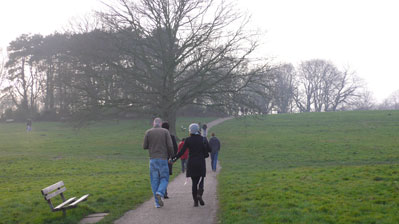
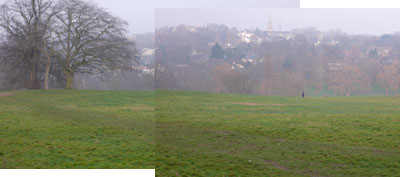
I awoke early on Sunday to catch the rising sun on Hampstead Heath, but when I looked out the window I found there was a lot fog. I would not be able to get even semi-clear shots of London and I didn't need a lot of excuses to stay in bed.
Still I did manage to catch the sun going down. It was a beautiful day, sunny, but with a little mist and fog leftover from the morning. This was actually better than the clear conditions I had several weeks ago. I imagine Paul waking to see a little mist over London.
But I was really looking for a location for scene 50, where Claire runs after Nick into the park. She has dismissed him, realising that they have been both deluding themselves. But when he is gone she has a relapse. Was this real? She goes after him.
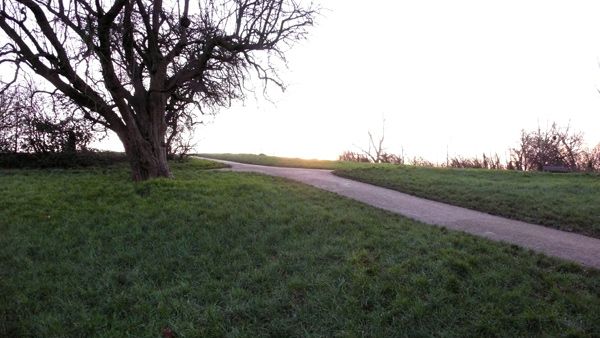
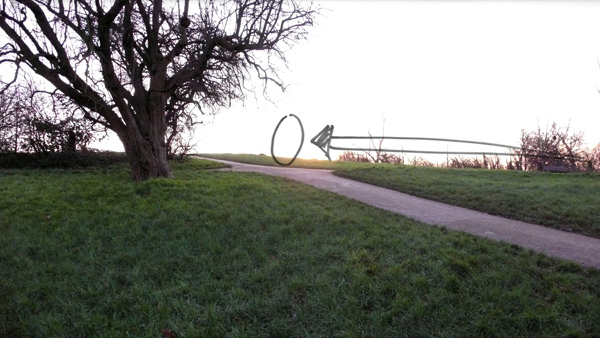
I had early posted some images of a place where two paths cross, but I was not happy with this location. One of the trails ascends quickly. She really needs to be looking down when she looks for him. Why not turn the camera the other way? It seems obvious, but there are a set of trees at the bottom of the crossing so she would really be able to see anything. Not what is required. So Sunday I was looking for another location.
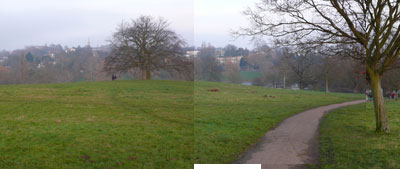
I found another hill on which a trail ascends and there is clear vantage point.


There is no crossing on this hill, but I realised this is for the best: the crossing image has the potential to be read as some sort of symbol (she is at a crossroads, blah blah), something I am desperate to avoid.
So I went up the hill.


There is a the clear line of the path below and the rest of the hill.
I liked the mix of hills, and banks of trees that create a series of background and foreground images.


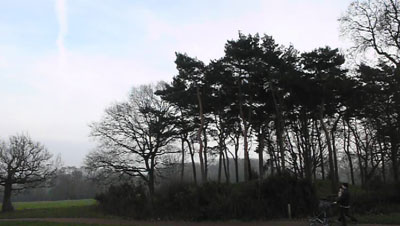
To her right were a stand of trees with a flock of black birds nesting at the top. I assumed they were crows.


They created a Hitchcock quality to the scene - inappropriate for my film, but it added to the fun of the afternoon.
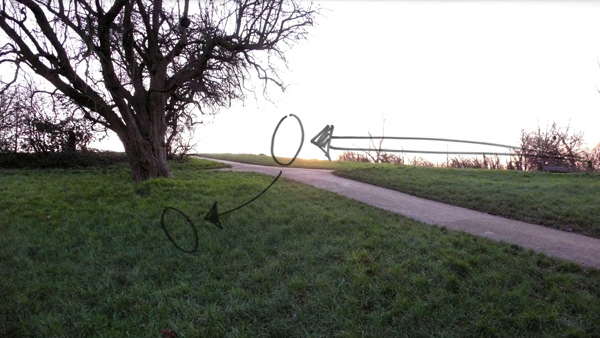
From the vantage point in the park she should be able to see him. But he has disappeared.
She wants to accept defeat. Near the path is a tree, and she comes onto the grass and collapses. Surrenders.
She scans the sky for some relief, but there is none. A nothing.


Then the iconic moment.

Sunday, February 04, 2007

Schrader and the Transcendental Style

I mentioned earlier that I was working my way through Schrader's book, Transcendental Style in Film (available on ABEbooks or Amazon). It analyses the films styles of Ozu, Bresson and Dreyer and shows how by way of form they create a transcendental style.
I have only just begun working my way through the Ozu section. Here Schrader first unravels the personality of Ozu, and his culture, from the transcendental style.
...the common qualities of transcendental style and take the form of three progressive steps.
1. The everyday: a meticulous representation of the dull, banal commonplaces of everyday living...

This quality strips the action of any expression, and in this way differs from what is known as realism. There is no drama, no melodrama. This quality, this silence, prepares the ground for the transcendental.
Ozu was quite famous for his austere style. As his career progressed he used fewer and fewer conventional film techniques.
He almost always placed the camera at the same height, that which the viewer would see another sitting on the traditional Japanese tatami mat. The actor faced the camera directly. The camera never moved.
I wondered how these everyday events differed in the work of more contemporary artists. Think of Kieslowski in The Double of Veronique. Veronique at home, reading a book, dozing in a chair. In interviews Irene Jacob said how these were not the events one described to a loved one at the end of the day. There is no drama or interest. But it is in precisely these mundane events that are filled with feelings and premonitions. These events completed the character.
I need to read more of Schrader to say if Kieslowski is doing something completely different in his work.
I am also reminded of Haneke, and the different way he uses mundane events in two of his films, 71 Fragments of a Chronology of Chance, and The 7th Continent. I have described these scenes earlier, and I feel confident saying that Haneke is not interested in the transcendental. But what is he doing then?
2. Disparity: an actual or potential disunity between man and his environment which culminates in a decisive action.

For the Zen philosopher, like Ozu the tension comes about when man is not one with nature.
In Ozu these disunities might be may be something as dramatic as a character suddenly breaking out in tears (Setsuko Hara), divorced from psychological realism and cause and effect. But Ozu being Ozu the disunities are generally not so dramatic. It may be an ironic comment, such as the Mother in Tokyo Story saying with irony 'what a treat to sleep on my dead son's bed'. The irony is usually a symptom of this disunity, and creates a tension that in a conventional film must be resolved.
The final step is:
3. Stasis: a frozen view of life which does not resolve the disparity but transcends it.
In Ozu's zen universe man is again one with nature, and may be indicated by his codas, those static shots of everyday objects, such as the equipment in the sake factory in The End of Summer. Or the different shots of the vase in the near the end of Late Spring. It suggests another reality beyond the mundane events described early.
Kieslowski seems to describe the transcendental very differently. For example, when Veronique is awoken from her sleep by the light flashing in her eyes. At first she thinks it is schoolboy trick. A boy across the way is playing with a mirror. But when he goes inside the light returns. This technique is very different from Ozu's codas.
I will talk more of this as I go further into the book.

Friday, February 02, 2007

Progress report

Just a short post to update you on the project. What have I been doing?
I am near completion of the first draft of the script - it would been complete last weekend but for some ideas I wanted to explore. I have added these into the outline and just need to put them in the script.
I am looking forward to taking a break from writing. I am sure you screenwriters understand how preoccupied you become getting close to finishing a draft.
On Sunday I will be up early scouting for locations in Hampstead Heath. I hope to upload a lot more photos in the next few weeks.
I have been reading a great book by Paul Schrader, Transcendental Style in Film, which discusses Ozu, Bresson, and Dryer. Much more on this soon.

Wednesday, January 24, 2007

Claire, the iconic look and locations

I mentioned some time ago that I had begun to scout locations.
Several weekends ago I was Hamstead Heath. I chose this park because of Parliament Hill, the highest point in London. Here Paul spends the night, and awakes to see London below him.
I did not find the images I wanted so more on that later.
But I was also interested in looking for locations for Claire's story: the final scene of her part, where she pursues Nick into the park.
This requires a location where several paths cross:


I remembered this location from when I lived nearby. It is not ideal, as one path looks up (to Parliament Hill), not down. I will look for another crossing the next time I am back.
I have Claire entering from the right, then turning her back to the camera and looking to the background and left. From this crossing she is able to see in three different directions and Nick is nowhere to be seen (this is the way I set it up in the workshop before Christmas).


Weary, defeated, she wants to surrender.
She turns to the grass (where the camera is set) and comes towards it. She almost collapses.


She scans the night sky, but it is a gray nothing. No relief anywhere (I have some video of this idea I shot in the summer).
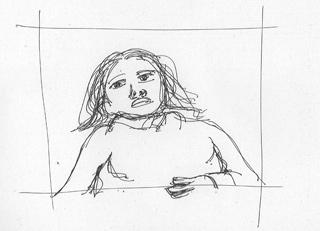
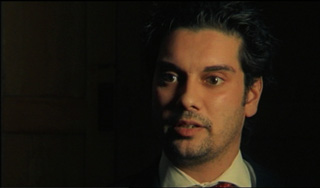
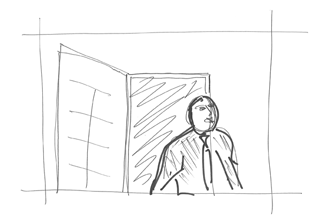
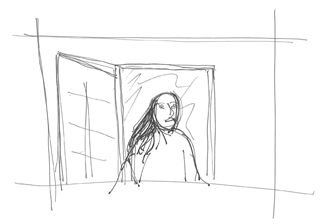
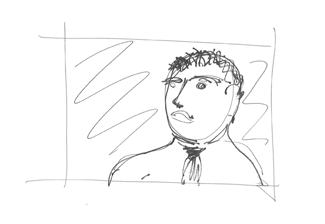
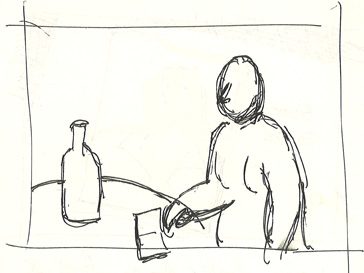
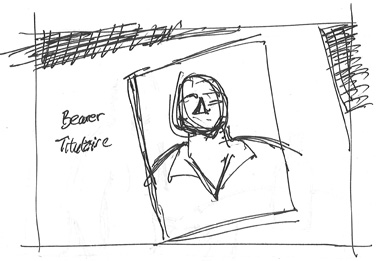
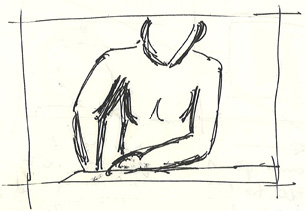
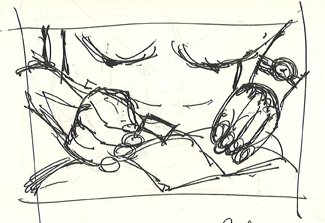
Then the iconic look. She looks directly at us/the camera. A drawing I made from the workshop video:


(as you can see there is no danger of me ever getting a job as a storyboard artist)

Sunday, January 21, 2007

My script and the 1 page = 1 minute rule

I am close to finishing the 1st. draft of the script and there is something alarming: it looks to be about 60 pages long, which is well short of a conventional feature-length script.
I am sure most of you are aware of the general rule that one page of a script generally equals one minute of screen time. A script must formatting in a certain way, with margins to certain sizes, and the Courier font set at a certain point size (I have a Word template that does all this for me, so I don't know all the numbers offhand). Production companies require this so that they can quite reasonably determine how long the film would be and so much it would cost.
I think if I submit this script to a reading service I can expect them to say either that the script is too short for a feature or that due to the style it is impossible to determine the true length. I think the latter is the truth.
I have been busy this evening timing some of the scenes from the workshop, and even without the insert shots scenes are coming to be one page of script equals two to four minutes of screen time.
I wonder if anyone else has had this problem?

Tuesday, January 09, 2007

The workshop and the iconic look

Last weekend I completed the revisions on the outline. It was painless. The workshop made the strengths and weaknesses so clear.
Going over the video record I was struck by how good my actors were (I find it difficult to notice in the middle of the workshop, struggling to keep them in the frame of the camera).
I was especially happy at the effectiveness of the iconic look, the moment of recognition. The actors jumped in and committed to it.
For Sophie: she has come through the dark passage and come into the parking garage. Fear is overcome, and she has broken through. Released. Then the moment of recognition. Of what? It is not about what she has been through. More, about where she is going. The next scene. She has allowed herself to let it be.
For Claire: until now she has never really looked at anyone. She cannot see what is immediately in front of her. But just before this scene, with Nick, she has been able to finally look at someone. She has understood his weakness, thought of someone else, which for her is progress.
She has a relapse. She wants it back, even though it is a lie. She rushes to the park, thinking of calling him back, but he is gone. Nowhere to be seen.
She turns away and goes to the grass, nearly collapsing. She cannot hold herself up any more. She lies on her back scanning the dark, gray sky. But it is a nothing. No break anywhere.
And then the iconic image, the moment of recognition. She realises she will not be allowed this.
(I will have more to say about this scene later: on early Sunday morning I was scouting locations for this scene).
I think Paul' moment is the least clear.
It starts with confusion over it's placements. The moment precedes the scene where he breaks into Sophie's house. He believes that he can somehow know her by seeing the mundane, everyday elements of her life. Perhaps he is right.
In the workshop my question was would it be more logical if it followed the break-in? It all depends. The question then is, what is Paul when he breaks in? Or more importantly what is Paul in the forest?
This is Paul at the trees. It begins with frustration and anger. It is place he can break something without consequences. He takes his revenge, or attempts to. Actually it is not so easy to break large tree branches. More than just frustration, Paul is struggling not to submit to the universe, becomes small. He is not going to drift with it, but swim against it. And he fails, and becomes the animal he was struggling against. This is the moment of recognition. He has become what he has always fought. He is no longer the complete man that Sophie rejected.
Now if the break-in is to follow...what does it mean? Paul is able to go to a place where he is no longer concerned with normally acceptable behaviour (this is not the man Sophie saw give that too perfect presentation on the day his wife left him). Does this ring true?

Kieslowski vs Haneke

I recently purchased the Michael Haneke Trilogy which includes The 7th Continent, Benny's Video, and 71 Fragments Of A Chronology Of Chance. I recommend these films, but only on days when you feel good about yourself (http://www.play.com/DVD/DVD/4-/1120303/The_Michael_Haneke_Trilogy/Product.html). They are difficult.
What struck me about The 7th Continent was Haneke's use of fragments of everyday, mundane events. The husband tying his shoes. The family car being washed. Breakfast being cooked.
Their use here contrasts with 71 Fragments, where the fragments are static, single shots, making up a single scene (he uses this method again Code Unknown), short or long (up to 9 minutes), which describe an emotional note.
In interviews Haneke has said the family in The 7th Continent is living a life of routine because that is all there is. The realisation comes to the wife in a powerful scene as the family car is put through the car wash. She despairs at this life, where life is not lived. She turns to her young daughter for comfort, instead of her husband who can do nothing.
I won't tell you what happens, but only say from this point the story goes in another direction (even though these events are still presented, by Haneke, as everyday - he doesn't falsely dramatise).
In The Double of Veronique Kieslowski uses the everyday/mundane in an altogether different way. Irene Jacob tells how together developed sequences of everyday actions that are full of feelings and premonitions. These moments of solitude can bring moments of completeness. These events are not what is talked about at the dinner table at the end of the day, but they are where life is lived.
I don't believe Haneke used the everyday/mundane this way in 71 Fragments. In this film he fills these type of events with critical moments. A women brushes her teeth. Suddenly she lets out a sob. That is all. The effect is powerful, because that is all we know.

Wednesday, January 03, 2007

Update

I looked forward to returning from the holidays ready to begin revising the outline. Unfortunately, I picked up a cold in Berlin so my I worked much slower than I would like.
Still, I did manage to begin transcribing some of the improvisations, removed a few scenes, and wrote several new ones (and in Berlin I did come up two short scripts as well).
Part 1 (Sophie): rewrote two scenes which were left-overs from previous versions. They had their place there, but not in this version. The new scenes:
Party. Paul and Sophie. Some simple images: Paul in groups, bored, distracted, looking to Sophie.
Sophie, in groups, engaged, interested. And never looking for Paul.
The way home. Paul, jealous, angry, confused. He can't really get angry because it seems so petty, but he realises that she is drifting away.
Sophie decides to give him a chance to understand. She stops the cab they are traveling in. They are in the middle of nowhere. She wants to get out and walk. She asks Paul to come with her. She just wants to know what may happen. But Paul does not understand, or understands enough that he is not capable of going with her.
These scenes also make what Sophie wants clearer as well.
I also added several of the everyday scenes that the actors conceived in the workshop. Two of them came from Scene 4. This is a dinner scene where Paul and Sophie first broach the issue that is causing Sophie to pull away from Paul: chance versus destiny.
We created two out scenes from Scene 4.
One was to see Paul washing the dishes and pots. This is a man in control. And this night more than ever he needs to control events, even if it is only the pots and pans.
This is mainly a moment of reflection.
The other scene is Sophie preparing for bed: she enters the bedroom and fills a glass with water on both sides of the bed (Paul and Sophie).
There is less reflection here. More a sense of how repeated events carry us through difficult times.
I was interested in both of these scenes in how they are filled by the characters. I thought of them as barometers of where the characters are at that moment, between their interactions.
And I also saw how these are different than the way that Haneke uses events like this in films such as The 7th Continent. More on that in the next blog post.
Part 2 (Claire): Helen (who played Claire in the workshop) pointed out a contradiction: Claire takes up with Nick, her sister Natalie's boyfriend, because she wants to the subject of an obsession. But as written Nick is not obsessed with her. He actually treats her quite well. This was just one part of a lack of consistency and quality at the end of Part 2.
I rewrote several scenes. I think it makes a lot more sense that Nick is obsessed with Claire, like he was Natalie. Nick projects onto Natalie, so he is as dishonest as Claire. And that is what Claire discovers. She actually is able to see another, which for Claire is progress.
We were also able to develop Sophie's character here: the focus in Part 2 is Claire, but we need to understand that Sophie has another thread, another life that she is living, even though we only catch a glimpse of it.
Scene 35 is a cafe meeting between Claire and Sophie. Sophie catches Claire out at her self-deception. She does not mean to be malicious, but she is worried, jealous, and too honest. So Claire leaves her there. But the scene doesn't end. I think it is important that the story is allowed a small tangent (it reminds of the those other stories we catch in Antonioni's The Passesnger). And somehow (we needed to develop this) Sophie cracks. She is in despair and probably came here really needing to speak to Claire. She won't get a chance.
I have much more work to do. The plan is to revise the outline by this coming weekend. And then begin writing the first draft of the script.

Friday, December 22, 2006

The workshop

The workshop finished a few days ago, and I am exhausted, in part from talking too much, but also because my head has been filled with so many questions and new ideas.
It exceeded my expectations. The actors, Phil, Emma, and Helen, jumped in and pushed the story about, asked a lot of questions and came up with some great suggestions. It moved ahead more in those three days in the workshop than in two months locked in my room.
Some successes:
Despite some gaping holes in the story (which became apparent in preparing for the workshop) overall it worked. The actors understood the characters, and could add layers on top of what I had come up with.
I experimented with the iconic image. Did it belong in the story? Yes, it is a very powerful idea, especially considering the structure of three stories. Should it happen where it does, eg. was this the moment of recognition for the character? Yes, most certainly, though Paul's moment needs to be clearer.
Needs development:
I played with the idea of abstractions for each character, but its use was limited. Partly this was purely practical. We needed to be in that room, that place, hearing that sound, seeing him or her through this or that, or holding or touching or feeling that thing. We weren't.
Partly this was because the abstraction is also created in the shooting method, and the actors were uninterested in this, and shouldn't be.
And most importantly the abstraction needs to grow more from the character and the actors were only just finding and discovering this person.
I have a lot more to think about over the next week. I am on holiday until December 28th and then I will have some more to say.

Wednesday, December 13, 2006

The abstract to the metaphysical

I have been busy preparing for the workshop next week. I have of course realised that even three full days is not enough to explore all that I am interested in. So, I will have to make some decisions.
Of course, I always intended to develop this story with actors and improvisation, in a workshop situation. I think that you only need to have someone, especially an actor, read your work out loud , and you quickly sees the problems and errors. A great way to regain your objectivity.
But it is far more than that. I am really interested in seeing what the actors can do improvising alone - not speaking, just doing, and what meaning can be infused into the story.
And also improvising everyday things. Those parts of the day that I have not written into the script. Brushing your teeth. Doing the laundry. Drinking a glass of water. I think that scenes like this provide a sense of the completeness of the person. Again, what meaning can be infused into the story?
And finally what has been referred to as abstractions (again see Joseph Kickasola and The Films of Krzysztof Kieslowski), which can be character's gestures, an object that the character refers to, the way an character looks at the world, literally, or just the way that some part of the character is shot. These abstractions seemed to suggest another level, above the literal or real world around us. Perhaps the metaphysical. Kickasola, in his book on Kieslowski, discusses the many abstraction of hands, specifically in Red. In this way a sequence opens with a close-up of a pair of hands. We don't know whom they belong to. They live in a place beyond the real. Or the opening of The Double Life of Veronique. Dark as night at the top, then dark blue and purple. Flashing lights. Then that strange curve towards the bottom. Soon we learn that it is a view of the city at dusk, seen upside down. This is Veronique, as a little girl, turned upside down, looking out at the sky.
Each of my main characters have motifs, if you will, which are abstracts. More on that in the next posting.

Wednesday, December 06, 2006

Next phase

Just a small note to say that I am busy preparing for a workshop of the script December 18th-20th. I have found three actors who will me develop the story in improvisation. I am especially interested in what we may create with the character alone, without dialogue.
I will be experimenting with a lot of what I have been discussing here, including the shooting style, the iconic pose, temp mort, the long take, etc.

Kieslowski and the iconic image

There is something that I am interested in and I have so far failed to mention. This is the iconic look or pose, seen in both Tarkovsky, and especially Kieslowski.
At a certain moment actor breaks the fourth wall, and looks right into the camera.
You can see this moment in almost all of Kieslowski's later films.
An example, in Blue. It is the day of the funeral of her husband and daughter. Julie burying herself beneath the covers of her hospital bed, watches the proceedings on a small television. She runs her fingers across the image of her daughter's small coffin. In extreme closeup, the edges of her mouth turn up. Some tears flow. Then the television goes blank, and Juliet Binoche looks directly at us. A picture of grief. It is most uncomfortable, so boldly addressing us in this way.
If I was at film school and did such a thing I would probably fail. And to be fair, it is not something to be done without good reason.
In my research I have been reading The Films of Krzystztof Kieslowski, by Joseph Kickasola, which discusses this motif in some detail.
Kieslowski chooses his moments, when the "metaphysical weight of the scene warrants reflection". We are forced to become involved.
Kickasola goes on to discuss the source of the iconic pose in Kieslowski's Catholic heritage, the religious icon painting. (Of course Tarkovsky not only used the iconic pose, he told the story of one of the greatest icon painters, Andrey Rublev - http://en.wikipedia.org/wiki/Andrey_Rublev)
[The icon plays] an intermediary role...between the perciever and God.... [At] the heart of this image is a new sprirtual dimension that...opens up for the viewer by directly engaging him or her in a visual look. It functions as an arrest of the passive, voyeuristic mode of the spectator.
So why might my story justify the iconic pose?
In each story I am interested in that moment when the characters recognise where they have succeeded or failed. Sophie has overcomes fear, sets herself adrift. Claire knows she will never change, will never be able to give herself. Paul understands he has been defeated by chance, crushed, and worse, it is not personal. Each of these moments is about their relationship to the universe. They see where they stand.
Am I justified? I shall see.

Sunday, November 26, 2006

Antonioni and 'temp mort'

Just recently I finally managed to see Antonioni's Red Desert.
As I have been busy getting ready for the workshop in December I have been thinking of the idea of what has been called temp mort, which is seen in Red Desert and The Passenger.
The dead time is that moment when the characters have exited the scene and the camera lingers for too long on the empty space. In the conventional world of British cinema this would be considered bad form or sloppy editing, but here it suggests that this space is autonomous. It has its own reality and the story we are following just happened to occupy the space for a time.
(You can read much more about this idea in Seymour Chatman's excellent book on the director, Antonioni or, the Surface of the World)
A variation of this idea occurs in a number of Antonioni's film. In The Passenger, when Locke goes out into the desert to make contact with the rebels he sees a man coming towards him on a camel. He assumes that this man is his contact and as the man passes him the camera pans to follow the man. But it is a dead end. The man is not his contact and plays no part this story, though we assume that he has a story of his own.
For me the attraction is important for the first part of the three-part story, in which Sophie becomes aware of another reality, by the leaking of one into another. But in the story we only see two, whereas I want to suggest an awareness of all these possibilities, which I suppose is some moment of awareness of the infiniteness of the universe.
So temp mort would be used to suggest those moments when we become aware not just of one other possibilities, but an infinite number.

Tuesday, November 21, 2006

Photos from the film shoot

Here are two shots from the film shoot a few weekends back.


Wide-shot of Sophie. She doesn't want to get too close.


Close-up of Paul. This is the end of them, and he is not happy about it.
Thanks again to my friends Mansi and Ant for their time.

Wednesday, November 15, 2006

The new synopsis - 3 part version

Sophie (+ Paul)
For Sophie and Paul, it is over. They have had an ideal relationship and Paul struggles to understand how it went wrong. But for Sophie, that she is with Paul is down to chance. This means that good or bad could easily be reversed. All that stands in the way of these other possibilities is fear.
Claire, her friend, cannot understand how Sophie could throw Paul and a great relationship away. She is resentful, and reminds Sophie that it could've been her, Claire, that was with Paul. She could've been happy.
Paul recognises the danger to themselves - 'We are not an accident' - but it is too late. Sophie finds a way to overcome her fear and discovers another possible life.

Claire (-Paul)
In this story Claire has what she wanted. Paul. But they argue, Paul frustrated that Claire really is not committed or passionate about them together. Can Claire really change?
She sees her chance when her sister drops by unexpectedly. She is going away to get away from Nick, her boyfriend. He is too much. Can Claire look after her flat?
In Natalie's flat Claire finds photos of Nick. He has an intensity that is missing from her relationship with Paul. She decides to take a chance. She leaves Paul - just disappears and moves into Natalie's flat. And then she goes picking up the threads of Natalie's life, her friends, and work colleagues, and Nick. Her pretext is apologising for Natalie's bad behaviour, but her motive is to become someone else.
But can Claire finally change?

Paul (-Claire)
With Sophie, Paul knew who he was and what he wanted, but with Claire he is another man. For Paul, Claire's reticence and secrecy are part of her inability to commit to their relationship, driving Paul to despair. For Paul, his relationships are fundamental to who he is as a person. Perhaps out of peevishness, or just confusion he spends the night with a stranger, and returns in the morning, wondering about the consequences. But Claire has disappeared. He begins to search for her and his first visit is Sophie. Looking beyond her hostility he is struck by the unfairness of chance: he could've been with Sophie, he could've been someone else. Feeling the weight of this injustice, his life goes into a spiral. Paul indeed becomes someone else. He is unrecognisable.

Tuesday, November 07, 2006

Film class excercise

I have also been busy with 16mm film class, which sets out to introduce the students to the basics of a film shoot.
Last weekend was the shooting weekend and I took the opportunity to experiment with the shooting style.
I chose a scene from the revised outline when Sophie returns from her night excursion. The night before, in the middle of a discussion with Paul about how they met, Sophie disappears. She goes out into the night, and discover a parallel world (London at night). It is really about her overcoming fear and reaffirming her belief in chance.
Now that it is morning she returns to Paul. She wants to explain, but Paul is too angry to listen to her.While Paul understood that their marriage is over, he did not expect it to end this way. It is almost that she had an affair over the course of the night. She has betrayed their intimacy.
I had intended this scene to happen in Paul's office, but we had to take what was given to us, which was a Victorian house.
Paul enters the room and we decided (we being Todd, acting as my DOP) he would sit down. He is distraught but his way to deal with it is to pretend to be in control. He of course betrays himself several times in speech. The camera would look down on him, so that we could express his lack of status.


Sopie follows him, but though she has been here innumerable times before this morning she doesn't feel welcome. She hovers in the doorway, in the centre of frame, at a distance. We don't come any closer, as if we could not know what is happening with her any more than Paul. She is in the centre of the frame as if she didn't need anyone. And the camera looks up to her. Her status is higher than Pauls.


Our reverse is a close-up of Paul - we do know what is happening with Paul as he does most of the talking - and he is frame-right, with a void frame-left. As if he were expecting Sophie to fill that empty space.


At least that was the plan. But as we were rushed (when aren't you rushed on a film set?) we made mistakes. We shot Sophie first, and had Paul feed her his lines off-camera. But we forgot to have him sit down, so her eye-line was level to him, instead of looking down to him if were seated. To match the reverse we had to Paul standing as well. We missed out being able to use camera angle to express status in the scene.
The film is currently in the lab. Next week we will be editing, and I will post some images.
Thank you to my friends Ant and Mansi for coming out on a Saturday afternoon to act for me. And Todd Pacey my DOP, and everyone else in the class.

Where have I been?

Whew!
It has been a long time, but it has been necessary.
I have completely revised the treatment/outline and I am now planning a workshop with actors for the end of November/early-December.
What has changed?
I think more has changed than stayed the same, but essentially it is simpler and clearer than it was before. I was especially conscious of removing the tricks from the script, which only served to get in the way. For example, in Part 2 Claire had a twin sister, who disappears. Claire, seeing that her sister is somehow able to be the passionate, committed person she wants to be, decides to take on her life and pretend to be her. Yes, I know.
In the revised version she still takes on her sister's life, but they are not twins and it is not a case of stolen identity.

Saturday, September 16, 2006

Long break

It has been along time, what with summer holidays, and the madness of work. I have begun a new draft, which is simpler and more focused. And also I have begun to find locations, and will begin to post images in due course.

Camera tricks

Thinking more on the The Passenger, and the scene that is known as the glideback (described below) - I wondered, does it matter that the glideback happens within one shot? I understand the objective is to contain a sense of truth and time, and that cutting would be considered a simple camera trick. But doesn't the audience accept the whole construct of cinema as a trick? And what bigger trick could there be in Locke climbing over the camera crew, doing a quick change, and then leaping out onto the terrace?

Tuesday, July 11, 2006

Tarkovsky and editing and rythm

So I am back with Sculpting in Time, thinking back to the same question: how do I shoot this thing?
I am looking to Tarkovsky to articulate some things I felt or thought. More develop than articulate.
First a rejection of Eisenstein and montage. He connects this with his rejection of the author's presence in the work.
When in October [Eisenstein] juxtaposes a balalaika with Kerensky, his method has become his aim...The construction of the image becomes an end in itself, and the author proceeds to make a total onslaught on the audience, imposing his own attitude to what is happening.
He would reject the idea of montage - that juxtaposition of two ideas creates a third - because the result is an idea. The authors.
Furthermore, montage suggests that the editor creates the rythm by this juxtaposition.
Tarkovsky would argue that the rythm exists within the shot itself:
Although the assembly of the shots is responsible for the structure of the film, it does not, as it is generally assumed, create its rhythm.
The distinctive time running through the shots makes the rhythm of the picture; and rhythm is determined not by the length of the edited pieces, but the pressure of the time that runs through them. Editing cannot determine rythm (in this respect it can only be a feature of style); indeed, time courses through the picture despite editing rather than because of it. The course of time, recorded in the frame, is what the director has to catch in the pieces laid out on the editing table.
So I would reject the conventions. Master shot, medium two-shot, close-up. These always seemed false to me, someone else's solution to someone else's problem.
I will struggle to find my own method.

Sunday, July 09, 2006

One-part version: just on the wrong side?

A friend of mine read the one-part version and said: I don't buy it.
Well, I don't buy it either. I wonder if part of my struggle in choosing is that I am unconvinced by this version.
And now, looking back on that scene in Mirror, I wonder if the flaw in the story is that we are witness to Sophie living that other life. Perhaps it would be better if, like Ignat, we are only aware of it from this side?
(This does mean that we are not witness to any less detail about this other life, only that we see from Sophie on this side.)

Thursday, June 29, 2006

Antonioni's The Passenger

I was very excited to finally see Antonioni's The Passenger.
As you can imagine I was attracted to the theme's of identity.
I was particularly taken with this scene, described below.
Locke (Jack Nicholson) is a television reporter working in Central Africa. He is there trying to get a story about a rebel movement, trying to overthrow the government.
But he has been frustrated at every turn, and it is clear that Locke is not a happy man.
He returns to his hotel and knocks on the door of another westerner, Robertson. But Robertson is dead.
Locke has decided to switch identities. Become Locke. He takes Robertson's passport and returns to his own room.


Locke at his desk. The two passports in front of him.


Locke looks down at the table, first at his own passport - the camera pans right to left - and then at Robertson's.


We hear a knock. Locke looks up. We think someone is at the door.
We hear Locke answer, but not speak. A flashback?
We hear another man. This voice must be of Robertson. Locke is remembering when he met Robertson.


Locke cuts out Robertson's passport photo.
We listen as Locke explains why he is in Africa.


From Locke the camera pans across to the chair. We see a tape recorder, and if we look carefully we see that it is running. This is not a memory of Locke's. It is a recording of a conversation.


Locke at his desk again. He looks up and the camera pans right to left again. This time to the window. Through the window we can see an empty terrace, and the desert in the background.
A man comes onto the terrace. We do not know yet that this is Robertson. He speaks to someone we cannot see.


Then Locke comes and stands next to Robertson. They look out into the desert.
We have slipped back in time.
Robertson tells Locke that he has been in so many places that it doesn't make any difference anymore. The key theme of the film is established.


We cut to a doorway. Locke and Robertson come and continue to speak.
Robertson tells Locke that he has no family, nor friends.
Locke goes off left to retrieve another drink. Robertson continues to speak to him, off-camera (he looks to our left).
Then the camera pans left to right. For the first time.


We return to Locke at the table. We have slipped forward in time.


Locke turns off the recorder.
The next scene is off Locke taking Robertson's body from his own room to Locke's. Robertson will become Locke. Locke, Robertson.
The switch is complete.

Wednesday, June 28, 2006

Tarkovsky and the other side

The other night, unable to sleep, I put on Mirror my laptop, and placed it next to my pillow. I often find that trying to read subtitles in a difficult Russian film at 3am makes sleep a little easier.
This night it didn't work. I went through Mirror for the 10th time. What I had forgotten was the amazing scene with Ignat, and Maria Nikolaevna. Ignat's mother leaves him in his father's flat waiting for Maria. He sees his mother out the door, crosses the hallway and is disturbed by the the sound of cups. Maria is there, at the table, looking for Ignat. There is a maid as well. And what was an empty hallway in the previous shot now includes chairs, mirrors, and lighting. She asks him to read from a book on one of the shelves, Pushkin's letters. As she listens the light in the room changes, as if the sun were slipping in and out from behind clouds.
Just as he finishes there is a knock at the door. Or rather Ignat looks to the door as if there was a knock. And Maria encourages him to open the door. But I could hear no knock.
He opens the door. It is an old woman. She looks confused, apologises, says she has the wrong flat and leaves (she looks like Ignat's grandmothers - we see photos of her later).
Ignat closes the door and goes back into the flat, but Maria has gone.
On the table, a circle of steam remains from where Maria's tea cup had rested. It quickly disappears.

Thursday, June 15, 2006

Coincidence and the past - II

Later, Claire and Robert are over for dinner.
Claire (now joined in this debate, it involves her too, it was crucial moment in her life as well) can produce polaroids of her flat. Of parties.
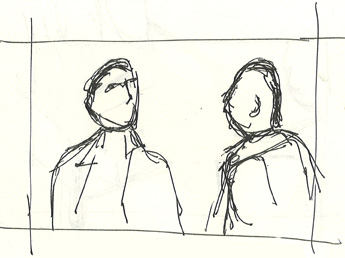
The debate is enlarged, revised, extended.
What would Claire feel?
This is the moment she lost Paul to Claire (and as a consequence ended up with Robert, a dead-end).
She would fear being drawn into their domestic squabble.
She would wonder at her current situation and speculate at how it could have all been different (and then we see the power of the three-part version of the story, as we see this to be a false hope. Her relationship with Paul is not any better than the one with Robert).
All this time Robert is in the background, listening.
Claire is aware of injustice and the universe.
She gets angry. At this game playing.
What the hell does it matter?
This is more likely. She pretend anger with Robert, but she is more angry with the universe.
Why has she been left out of the scenario/been done such an injustice?

Sunday, June 11, 2006

Three-part version: Paul (-Claire) synopsis

Paul (-Claire)
With Sophie, Paul knew who he was and what he wanted, but with Claire he is another man. For Paul, Claire's reticence and secrecy are part of her inability to commit to their relationship, driving Paul to despair. His relationship with Claire is fundamental to who he is as a person. Paul sets out to take revenge, spends the night with a stranger, and returns in the morning, wondering about the consequences. But Claire has disappeared, and when Paul sets out to find her, and learn who she was really was, his life goes into a spiral. It's as if he were no longer complete. It might look like a game, but for Paul it is critical. He does everything to find her, and with Sophie's help, tracks down Claire's twin sister, Natalie. His reception is not friendly. Claire and Natalie did not enjoy the novelty of being twins. They found it a challenge to their identity. But with a little charm Paul is able to able to talk to Natalie. He intrigues with the question, why did it not work with Claire and himself? It is as if Paul was smitten. If he can't have Claire perhaps he can have Natalie? Or is it really Claire? No matter.

Three-part version: Claire (-Paul) synopsis

Claire (-Paul)
But what if this were not true for someone? What if, no matter who they were with they were the same? That they didn't really change for they were with, and by implication, they didn't care. They weren't really affected by that person. This is Claire, Sophie's friend. In Sophie (+Paul) Claire's relationship with her husband is falling apart. She looks at Sophie's nearly perfect relationship with Paul and wonders what is wrong with her? What's more, when Sophie met Paul he was going out with Paul. But now in Claire (-Paul) she is with Paul. What would it be like to feel so completely for someone? The kind of relationship her twin sister Natalie has with Nick? Claire gets her chance when Natalie disappears. She takes up Natalie's life, and begins a relationship with Nick. Why? After the disastrous relationship with Paul she needs to find out if she can care.

Three-part version: Sophie + Paul synopsis

Sophie + Paul
Sophie has a great relationship with Paul. He knows who he is, and makes those around him comfortable. They live in the sky above the Thames, a hi-rise set of flats from where they can see river and the tidal barrier. But it all begins to fall apart one day when they begin to look into the circumstance of their first meeting: coincidence. This realisation means that any relationship, even a good one, is arbitrary, it could as easily not be. Paul recognises the danger. 'We are not an accident' and 'It's not that I believe in destiny, it's that I can believe in 'coincidence'. But it is too late. This begins to erode Sophie and Paul's relationship. At the same (or because of it?) they are 'haunted' by people or events from this 'other life'.

Haunted by the other 'life'

Both versions of this story begin centre on the the theme that each possibility of our life is equally legitimate. There are endless other lives, universes, or threads. We might have become these, or we may one day become them.
And in this story all the characters are in one way haunted by these other lives. I am deliberately playing on the horror/thriller genre here.
A recurring incident in Sophie's and Paul's story: one night Paul spys a car parked below their hi-rise flat. The engine is running and the wipers wave back and forth. Though it is impossible to see clearly because of the dark and the rain, both Paul and Sophie believe that the driver is parked there looking up at them in their flat, and that the driver is a woman. Paul is angry and threatened. He wants to confront the woman, though he cannot say why. Sophie is frightened and would rather hide in the bedroom than confront her.
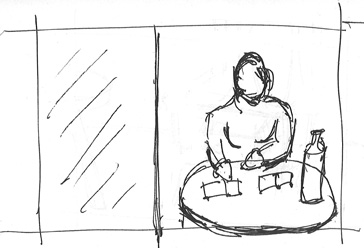
At the end of Paul's and Sophie's story Sophie is again at the window and the car is below.
In the car is Sophie too. Another thread. She is not with Paul (or with anyone). She lives in a house (not a flat) and struggles for direction (unlike the first Sophie who is so certain about what she is).

Coincidence and the past

One part of this story charts the downward spiral of Sophie's and Paul's relationship once they recognise that their near-perfect relationship rests on the coincidence and chance that brought them together.
Some of my critics accepts this, others don't. The doubters would say that it would not matter how the relationship began. What counts is the strength of their relationship. I would say that accepting a universe governed by chance and coincidence would make anyone doubt the veracity of any kind of relationship. What would this near-perfect relationship be based on? Such a thing could not exist.
So Sophie and Paul begin by disagreeing over the circumstances of their meeting. Paul must believe in fate because he cannot accept chance. That would be the end of them and he recognises the danger. Sophie believes in chance unconsciously, and if aware of the danger cannot turn from the conviction of the idea. They begin to re-rehearse the events of their meeting, a party at Claire's flat (Sophie's friend). What music was playing? Where were they sitting? How did they begin to talk? What sparked the relationship?
The debate can revolve around one incident - an accident? A lamp is pushed over. How did it happen? Paul can claim he did.
It altered the situation. A shared experience.
Paul spoke to Sophie. They had ignored each other until now. Did Sophie dislike him for Claire's sake?
Paul believed that Sophie was jealous.

Friday, June 09, 2006

Why Tarkovsky and the long-take?

I need to say more about the theme.
One tenet: that we are different people with different people. Who we are and who we might become is dependent upon who we are with now and who we are with (or without) in the future.
Time and chance define our identity. In the three-story version each thread is equally valid. One may show the characters in one situation (in part one Sophie and Paul are a couple) and another in a different situation (Paul and Claire are a couple, at least temporarily, and Sophie, Claire's best friend, doesn't particularly like Paul).
Other threads overlap. In two, Paul is the person Claire left behind. In three it we see much of the same story from his viewpoint. Much is the same. Some is different.
Each thread of time is equally valid.
This is where I make the leap to the long-take: each captures a segment of each thread. Each is true, for that moment in time. One does not supersede the other. Each successive shot amplifies the effect. The edits would come naturally, joining two captures of time. The approach to the shooting, the shooting style, cannot be divorced from the essence of cinema.
You can see how this would be the case with number of short-takes. I feel that the weight of time would be absent, dispersed. The edits more a case of convention than anything else. Coverage.
At the same time I am not suggesting that each take = the scene, as in Haneke's Code Unknown.
Taking this approach into the studio with the actors, the construct of the long-take will shape the scene, pushed in one direction or another.

Tuesday, June 06, 2006

How do I make this thing?

This is not all theory. I am truly struggling to conceive of a way to approach the shooting of this film.
Think of Wong Kar-Wai's In the Mood for Love. The couple are seen between lampshades, around doorways, below the jackets hanging in the closed. Snapped. Glimpsed. They are repeatedly reframed. Seen from this the same position, but with a different frame, different focal length.
What is this about? (I am under no illusion that there is great idea trying to break forth).
This is about memory. It is unreliable. Partial. Fragmented.
Also look at Michael Haneke's Code Unknown. Yes, long-takes, but more than that: each shot is a scene. Usually it the world of one character (though the street scene includes all the characters of the film, in some manner).
For example: a father at the farmhouse table eating a simple dinner. The young son has disappeared. Not a word. Ungrateful. There is a noise off. The son has returned. He passes the father and sits at other end. Says nothing. The camera does not follow him, does not establish him in the scene. It stays with the father. The father looks at him. He goes to the counter, gathers some dinner for the son, returns to the table, then follows the father into the toilet. He needs to hide his disappointment.
What about Tidal Barrier?
Imagine a framed shot. Sophie, one of the main characters. From this close-up a jump-cut to an empty frame. Slight pan to the right and the frame is found.
What is this about?
Another Sophie at another time.
The colour of her face could be different between the shots. Her features are different.
Or. The second shot, the same position, but a different focal length. She is further away - we are no nearer to understanding her - her face has changed (the colour, her face is in shadow), before we can know her she has changed again.
Or return to Tarkovsky. If the fundamental of cinema is capturing time, and the long-take is the evident way of doing so then is the long-take the central tenet of the shooting style of this film?