So I have had Ana and David over to see the edit on separate nights. Perhaps I should start with what was clear...
They both found the particulars of the story clear. That is they understood, or could understand where the characters were and who they were. They did not think it was necessary to explain more.
But at the same time they thought that there were missing steps in the relationship between Nick and Claire. They just barely begin their relationship and then it is over.
And the this was not helped by the fact we see no more than a short sequence with Claire and her previous relationship with Paul.
For them the visual language, or at least what was promised, was clear. (I found this interesting that for some the particulars, such as which flat the characters were in was confusing, but the abstract layer was clear. This for me is a victory).
David, being the photographer was more critical, but then that is why I asked him for his opinion. I certainly could not disagree with him.
As for the question of length, no one felt it was too long, that there was any fat. Quite the opposite. As I said, Claire and Nick needed more development.
So my problem remains. If I was to continue the way I had always planned then I would have a film of at least 2 hours.
What to do? Once they had finished their feedback I proposed them a solution. That is that this story would be developed into a feature of its own. This means creating a segment at the beginning, developing the relationship between Claire, Paul, Natalie, and Sophie. The second segment would stand, with some further developments between Claire and Nick. With the first segment, this second segment would seem as a natural development of Claire's story.
And then to follow, where does Claire go? This would be the third segment. Again, the natural development. If with Nick, Claire was foolishly taking on an other's identity, then third segment would be about her stripping away the artificial layers of identity.
I have already begun to write these new segments. I have written a draft of this first segments, I have developed the second segments, and I have very rough outline of the third segment.
Two of the actors, Flora and Katrine are coming over to see the edit on Thursday, and I will propose to them this new idea. More on that later...
Tuesday, March 25, 2008


Monday, March 17, 2008
The first edit and the first feedback
So I began to show the first edit to friends this past week. Actually the first were my two neighbours. Isabella and Mark. They knew nothing about the script and the story so I was especially interested to hear their reaction.
And quickly problems with the state of the edit arose, principally in that the story if tightly written that one missing detail made it difficult for them to follow what was happening. An example, I shot the scenes in Paul's/Claire's place here in my flat, and because I don't have the location as yet, Natalie's flat as well. This meant they simply had difficulty knowing when Claire was at her flat and when she was at her sister's, Natalie. The story is complicated enough that these small details made it difficult to judge the effectiveness of the story. Is there enough there? Do I need just a few more details, a little more explanation?
My instinct would be to add more, because I can always remove it in the edit, but for one other problem, the edit is running at 41 minutes. As this was intended to be one part of three parts, if the other parts were of equal length or if I have to add a few more minutes that would mean 3 x 43 minutes = 129minutes. If I was a name director perhaps I could interest someone in buying that, but since this is a debut feature that is unlikely to happen.
What are my options? Shorten it by cutting it tighter? I don't think there is a lot of fat to cut. I made it pretty lean from the beginning. I explain next to nothing, the minimal, to the point where I think it would be incomprehensible if it were cut it tighter. What about making it less complicated? I don't know if it would have the same resonance if I did this. Develop the Claire story as a feature by itself? Isabella was quite adamant that she would like this if the story were to develop, but not if it were to explain more.
There are two areas where it could be developed.
First the visual language is starting to be effective, even thought there are large gaps in it. I have not even begun to develop the language of the macro, that is Claire's world seen in the minutiae. I would need to make it longer to do this.
Second, to develop other characters in the story, before and after. The first part with Paul at the beginning. What is there in their relationship that Claire would try to take up Natalie's life?
Then her sister Natalie. What could be developed there?
And what happens after the final scene with Claire where she goes into the forest looking for Nick?
So I have a lot of thinking to do. In the meantime Ana is coming over on Wednesday and more feedback. If she were to have the same reaction...
And quickly problems with the state of the edit arose, principally in that the story if tightly written that one missing detail made it difficult for them to follow what was happening. An example, I shot the scenes in Paul's/Claire's place here in my flat, and because I don't have the location as yet, Natalie's flat as well. This meant they simply had difficulty knowing when Claire was at her flat and when she was at her sister's, Natalie. The story is complicated enough that these small details made it difficult to judge the effectiveness of the story. Is there enough there? Do I need just a few more details, a little more explanation?
My instinct would be to add more, because I can always remove it in the edit, but for one other problem, the edit is running at 41 minutes. As this was intended to be one part of three parts, if the other parts were of equal length or if I have to add a few more minutes that would mean 3 x 43 minutes = 129minutes. If I was a name director perhaps I could interest someone in buying that, but since this is a debut feature that is unlikely to happen.
What are my options? Shorten it by cutting it tighter? I don't think there is a lot of fat to cut. I made it pretty lean from the beginning. I explain next to nothing, the minimal, to the point where I think it would be incomprehensible if it were cut it tighter. What about making it less complicated? I don't know if it would have the same resonance if I did this. Develop the Claire story as a feature by itself? Isabella was quite adamant that she would like this if the story were to develop, but not if it were to explain more.
There are two areas where it could be developed.
First the visual language is starting to be effective, even thought there are large gaps in it. I have not even begun to develop the language of the macro, that is Claire's world seen in the minutiae. I would need to make it longer to do this.
Second, to develop other characters in the story, before and after. The first part with Paul at the beginning. What is there in their relationship that Claire would try to take up Natalie's life?
Then her sister Natalie. What could be developed there?
And what happens after the final scene with Claire where she goes into the forest looking for Nick?
So I have a lot of thinking to do. In the meantime Ana is coming over on Wednesday and more feedback. If she were to have the same reaction...
Monday, March 10, 2008
The final scene and a new location
Now that JC is away until mid-March I look to David to help me out.
I already posted previously of our problems with the park location. So the Sunday previously David showed me another park close to our original locations.
What I realised from shooting the other weekend was that this scene or scene require a location that can be seen as a periphery, where the city meets park meets the wild. The other location was only wild with some of the city at the far edge.
This location was more suitable.
The park meets a high street. I can suggest safety for Claire, not just physically, but also from what she fears in her mind.
So we can establish her meeting Nick for the first time in such a place.

Here they must sit and Claire tells Nick how irresponsible Natalie is. It is also the place that they end their relationship too.

An alternative meeting point which has the added value of including the next location in the background.

The park meets the wild, with the city in the background. A great intersection/conjunction.
There are also some lights, which will at least establish the presence or absence of Nick when Claire goes looking for him. He can disappear because we can see so.

And then the wild place, where Claire goes to meet her fears. The final shots take place in there.

I returned to this location this past Saturday and capture a whole series of shots to establish this part of the story.
I also found that finding these locations made to change the story. In this last scene, Claire does not go after Nick to learn if what had happened was real - I always found this idea weak - but rather to confirm what she had always feared, that she was essentially alone. When she goes into the wild it is to face her fear, which has now been well-established earlier in the story.
On Sunday I edited all the new footage together and reworked some of the sound. I will burn a DVD on Tuesday and then it is time for some feedback. More on that...
I already posted previously of our problems with the park location. So the Sunday previously David showed me another park close to our original locations.
What I realised from shooting the other weekend was that this scene or scene require a location that can be seen as a periphery, where the city meets park meets the wild. The other location was only wild with some of the city at the far edge.
This location was more suitable.
The park meets a high street. I can suggest safety for Claire, not just physically, but also from what she fears in her mind.
So we can establish her meeting Nick for the first time in such a place.

Here they must sit and Claire tells Nick how irresponsible Natalie is. It is also the place that they end their relationship too.

An alternative meeting point which has the added value of including the next location in the background.

The park meets the wild, with the city in the background. A great intersection/conjunction.
There are also some lights, which will at least establish the presence or absence of Nick when Claire goes looking for him. He can disappear because we can see so.

And then the wild place, where Claire goes to meet her fears. The final shots take place in there.

I returned to this location this past Saturday and capture a whole series of shots to establish this part of the story.
I also found that finding these locations made to change the story. In this last scene, Claire does not go after Nick to learn if what had happened was real - I always found this idea weak - but rather to confirm what she had always feared, that she was essentially alone. When she goes into the wild it is to face her fear, which has now been well-established earlier in the story.
On Sunday I edited all the new footage together and reworked some of the sound. I will burn a DVD on Tuesday and then it is time for some feedback. More on that...
Wednesday, March 05, 2008
Workshop complete...just about
So this past Sunday I finished the workshop, or at least most of it. It was a long day and I had to introduce Emma, who plays Sophie, into a few scenes, and some voice-overs, really phone calls. I also worked with Katrine, who has one scene as Natalie, Claire's sister.
With Flora we finally filmed scene 18, which was the scene I used to audition everyone. It was strange to do this scene as it felt as if we had already done it. In this scene Claire is awoken in the night by a strange sound. She thinks it may be intruders, but then realises she is really afraid that Natalie has returned. Then she learns that the odd sounds are her neighbour is having a bath. There is great relief.
I took this opportunity to add a new scene, or at least a part to scene 18. From JC' s and Fergus' feedback I was looking for ways to flesh out the relationship between Claire and Nick. So at the end of this scene Claire is seen watching someone from her bedroom window. She goes to the front door of the flat, unlocks the door, and goes back to bed. A short time later Nick comes in. They have started their relationship.
This scene or stub establishes their relationship, shows how Nick has transferred his obsession to Claire, as he has been watching Claire, and makes a connection between the idea of release, which is the focus of the scene, and her taking up this new life via a relationship.
I have more work to do, especially around the park scenes. If all goes well I will shoot those this weekend and finish the edit as well. Then it is time for feedback.
With Flora we finally filmed scene 18, which was the scene I used to audition everyone. It was strange to do this scene as it felt as if we had already done it. In this scene Claire is awoken in the night by a strange sound. She thinks it may be intruders, but then realises she is really afraid that Natalie has returned. Then she learns that the odd sounds are her neighbour is having a bath. There is great relief.
I took this opportunity to add a new scene, or at least a part to scene 18. From JC' s and Fergus' feedback I was looking for ways to flesh out the relationship between Claire and Nick. So at the end of this scene Claire is seen watching someone from her bedroom window. She goes to the front door of the flat, unlocks the door, and goes back to bed. A short time later Nick comes in. They have started their relationship.
This scene or stub establishes their relationship, shows how Nick has transferred his obsession to Claire, as he has been watching Claire, and makes a connection between the idea of release, which is the focus of the scene, and her taking up this new life via a relationship.
I have more work to do, especially around the park scenes. If all goes well I will shoot those this weekend and finish the edit as well. Then it is time for feedback.
Wednesday, February 27, 2008
The workshop - where we stand at the 3/4 mark
In a case of unfortunate timing JC is off to Hong Kong for a month, so I wanted to have come to at least some conclusions this weekend about how we might shoot the film. We still have one day to shoot, and we are missing some other parts, but I have edited what we have already shot, which was quite substantial, and put it onto DVD. JC was set to come over on Saturday so might get an objective look at where we were.
By chance my friend Fergus was in London for the weekend for a shoot. Now Fergus has not been involved in this project at all. If he were around a bit more I would've probably asked him to take a look at the script. As it was it a was great opportunity to get some quality, objective feedback.
So after struggling to connect the missing bits, and squint in the too-dark park scenes Fergus gained a pretty clear idea of where we going. His feedback?
Dialogue. Too often the little dialogue there was too loaded and not necessary. Now, I am always very happy to get rid of dialogue but it was great to hear it from someone else. Fergus just felt that so much of what was either clear visually or actually acted to restrict what he thought was happening.
Visual language. That this was strong enough or could be developed enough to more than compensate for what the lack of literal information. So, as I said in my last post, this is something I will develop next week when I meet with David.
Information. That there is too much plot so that the story is weighted down by the dialogue. It is not that important. He suggested an alternative way in which the exposition could unfold, but I am not sure that this would not create an entirely different film. Still, his point is well taken. In the first park scene, where Claire first meets Nick she explains about Natalie and how she has always been irresponsible. But when we shot it, due to the distance from the camera we could not hear what she was saying. Fergus did not miss this dialogue at all.
JC made another good point, something that I had suspected before, that we are missing steps in the relationship between Claire and Nick. We see the beginning and end of their relationship, but not the lead up to it, and not the centre of it. I wondered if we need at least another incidents between them to round out their relationship.
Before JC left we managed to agree that the original idea we had for a shooting style still seemed to be sound. That is the majority of the film is composed by static shots, but that we find those places where might move the camera.
By chance my friend Fergus was in London for the weekend for a shoot. Now Fergus has not been involved in this project at all. If he were around a bit more I would've probably asked him to take a look at the script. As it was it a was great opportunity to get some quality, objective feedback.
So after struggling to connect the missing bits, and squint in the too-dark park scenes Fergus gained a pretty clear idea of where we going. His feedback?
Dialogue. Too often the little dialogue there was too loaded and not necessary. Now, I am always very happy to get rid of dialogue but it was great to hear it from someone else. Fergus just felt that so much of what was either clear visually or actually acted to restrict what he thought was happening.
Visual language. That this was strong enough or could be developed enough to more than compensate for what the lack of literal information. So, as I said in my last post, this is something I will develop next week when I meet with David.
Information. That there is too much plot so that the story is weighted down by the dialogue. It is not that important. He suggested an alternative way in which the exposition could unfold, but I am not sure that this would not create an entirely different film. Still, his point is well taken. In the first park scene, where Claire first meets Nick she explains about Natalie and how she has always been irresponsible. But when we shot it, due to the distance from the camera we could not hear what she was saying. Fergus did not miss this dialogue at all.
JC made another good point, something that I had suspected before, that we are missing steps in the relationship between Claire and Nick. We see the beginning and end of their relationship, but not the lead up to it, and not the centre of it. I wondered if we need at least another incidents between them to round out their relationship.
Before JC left we managed to agree that the original idea we had for a shooting style still seemed to be sound. That is the majority of the film is composed by static shots, but that we find those places where might move the camera.
Wednesday, February 13, 2008
inserts versus codas
JC has this dislike of inserts and I feel the same. By inserts I think of shots that are there purely for information, as in the actor is looking at their phone. Insert: CU of their phone and we see who is calling. Sometimes you have no choice but when you can...so I managed to get rid of just such an insert.
It was the park scene we shot the previous weekend. Here we see that Claire has made contact with Nick, and enough has transpired between them that we see they are comfortable, even intimate together. The setting, and the weather on this particular shooting day, amplify what Claire has achieved in making this leap to become someone else but starting a relationship with Nick.
But still it is a lie, and it is Sophie's presence, in the form of a series of phone calls to Claire's mobile that gives it away.
After we have established Claire and Nick's relationship and setting I have Claire sneaking away from Nick to check her phone messages.
Then the dastardly insert of Claire's mobile phone: Missed calls: Sophie (7)
But I realised that what was important in this scene was that Claire had broken away from Nick and in effect the whole construct to check her phone. It was the fact of the lie that was important, not the content of the lie.
And in the next scene we find out who it was who called and the substance of her calls.
The insert is unnecessary.
Now what I don't mean by inserts are those abstraction you see in an Ozu film or Kieslowski and so many others. I have read these referred to sometimes as codas which made little sense to me at first. I thought of that word in reference to music, the concluding part of the whole piece of music. But coda can refer to something brings to an end the preceding part, not just a whole. If you thought of Ozu and his static shots in The End of Summer you can see how they end and summarise the preceding scene or scenes.
In a coda there may information but there is something more. Kieslowski creates abstractions as a layer of the story's language. I think of Blue and the scene where Juliette Binoche is having coffee and we cut to a close-up of the sugar cube, held just at the surface of the coffee, absorbing the liquid. What does this mean? It is hardly necessary for information. Do we need to know that the character takes one sugar cube with her coffee? Kieslowski talks about this himself in the DVD extras. He wanted to show how the character was looking inward, in her own world. The lighting, which was high-contrast, and the focus, which was shallow, added to this effect.
And so far this is one of the weaknesses of the Claire part of this project - and I am certain that I have said this in previous posts. I have not developed my codas, or the layer of abstractions sufficiently. So, I need to get on to it.
Next weekend I am planning to work with David to develop just this.
It was the park scene we shot the previous weekend. Here we see that Claire has made contact with Nick, and enough has transpired between them that we see they are comfortable, even intimate together. The setting, and the weather on this particular shooting day, amplify what Claire has achieved in making this leap to become someone else but starting a relationship with Nick.
But still it is a lie, and it is Sophie's presence, in the form of a series of phone calls to Claire's mobile that gives it away.
After we have established Claire and Nick's relationship and setting I have Claire sneaking away from Nick to check her phone messages.
Then the dastardly insert of Claire's mobile phone: Missed calls: Sophie (7)
But I realised that what was important in this scene was that Claire had broken away from Nick and in effect the whole construct to check her phone. It was the fact of the lie that was important, not the content of the lie.
And in the next scene we find out who it was who called and the substance of her calls.
The insert is unnecessary.
Now what I don't mean by inserts are those abstraction you see in an Ozu film or Kieslowski and so many others. I have read these referred to sometimes as codas which made little sense to me at first. I thought of that word in reference to music, the concluding part of the whole piece of music. But coda can refer to something brings to an end the preceding part, not just a whole. If you thought of Ozu and his static shots in The End of Summer you can see how they end and summarise the preceding scene or scenes.
In a coda there may information but there is something more. Kieslowski creates abstractions as a layer of the story's language. I think of Blue and the scene where Juliette Binoche is having coffee and we cut to a close-up of the sugar cube, held just at the surface of the coffee, absorbing the liquid. What does this mean? It is hardly necessary for information. Do we need to know that the character takes one sugar cube with her coffee? Kieslowski talks about this himself in the DVD extras. He wanted to show how the character was looking inward, in her own world. The lighting, which was high-contrast, and the focus, which was shallow, added to this effect.
And so far this is one of the weaknesses of the Claire part of this project - and I am certain that I have said this in previous posts. I have not developed my codas, or the layer of abstractions sufficiently. So, I need to get on to it.
Next weekend I am planning to work with David to develop just this.
Tuesday, February 12, 2008
Workshop - the park location
This past Sunday Flora, Phil, JC and myself went to Snaresbrook to shoot the park segments of the workhop.
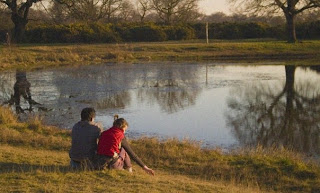
The day started out well as you can see. As I was waiting for the others to show up I did some thinking. I deleted two shots and added one.
This is a still from this new shot. In this part of the story Claire has joined up with Nick, her sister's boyfriend. Here, in this place, they have managed to create a level of intimacy. The story has opened outwards, at many others enjoying this day, looks up at the trees and the sky, and down at the grass and the water.
But it can not be sustained. Claire sneaks away at one point to check her phone. We don't find out until the next scene why, but we know that somehow the truth has not been told.
Later we moved to another location where we worked on the other park scenes.
There is one, where Claire first meets Nick, and another where they end it.
And there is the final scene, where Claire realises that she is not able to change, and can find no answer for it anywhere.
Here we found it difficult. First, the location was not ideal. We could not stitch together all that we needed to create the scenes.
And second as we struggled to put it together it became too dark to find a solution.
We hacked something together for the workshop video, but we clearly have more work to do.

If I close my eyes perhaps he'll just go away.
Photos by JC.
The day started out well as you can see. As I was waiting for the others to show up I did some thinking. I deleted two shots and added one.
This is a still from this new shot. In this part of the story Claire has joined up with Nick, her sister's boyfriend. Here, in this place, they have managed to create a level of intimacy. The story has opened outwards, at many others enjoying this day, looks up at the trees and the sky, and down at the grass and the water.
But it can not be sustained. Claire sneaks away at one point to check her phone. We don't find out until the next scene why, but we know that somehow the truth has not been told.

Later we moved to another location where we worked on the other park scenes.
There is one, where Claire first meets Nick, and another where they end it.
And there is the final scene, where Claire realises that she is not able to change, and can find no answer for it anywhere.
Here we found it difficult. First, the location was not ideal. We could not stitch together all that we needed to create the scenes.
And second as we struggled to put it together it became too dark to find a solution.
We hacked something together for the workshop video, but we clearly have more work to do.

If I close my eyes perhaps he'll just go away.
Photos by JC.
Wednesday, February 06, 2008
Workshop
As always, the more I have to say the less time I have to say it.
I have been busy, these few weeks work shopping the script.
Two weeks ago I worked with my lead, Flora, shooting a number of scenes where she is by herself.
Last Sunday I had both Flora and Phil together for the first time. You always worry how people will get along but as it turned out everything was great fun.
Now looking back on it perhaps I should have done it the other way around? How would Flora have approached those scenes after she had a chance to be Claire first working with Nick? In the end it doesn't matter. The whole point of working this way is that we are able to go back and change and alter and rethink what we have done.
JC joined us this past Sunday, experimenting with a variety of ideas. This way the story, the acting, and the shooting style can all grow together. Unfortunately he is off to Hong Kong at the end of February, for one month, so we need to have done a lot of thinking between now and then.
This Sunday, weather permitting, we are planning to shoot all the scenes that take place in the park. I think we have one more day after that, to pick up the odd scenes, and then we have shot the whole story. I have already begun to edit the video, so I should begin to have rough edits of the workshop video in two weeks. Then it is time to call in friends and neighbours for feedback.
I have been busy, these few weeks work shopping the script.
Two weeks ago I worked with my lead, Flora, shooting a number of scenes where she is by herself.
Last Sunday I had both Flora and Phil together for the first time. You always worry how people will get along but as it turned out everything was great fun.
Now looking back on it perhaps I should have done it the other way around? How would Flora have approached those scenes after she had a chance to be Claire first working with Nick? In the end it doesn't matter. The whole point of working this way is that we are able to go back and change and alter and rethink what we have done.
JC joined us this past Sunday, experimenting with a variety of ideas. This way the story, the acting, and the shooting style can all grow together. Unfortunately he is off to Hong Kong at the end of February, for one month, so we need to have done a lot of thinking between now and then.
This Sunday, weather permitting, we are planning to shoot all the scenes that take place in the park. I think we have one more day after that, to pick up the odd scenes, and then we have shot the whole story. I have already begun to edit the video, so I should begin to have rough edits of the workshop video in two weeks. Then it is time to call in friends and neighbours for feedback.
Saturday, January 26, 2008
Workshop preparation...
So I am now in the process of preparing for the workshops. They will take place on weekend days and evenings throughout February.
Part of the preparation was creating a shot list and then a storyboard, drawing out what I imagined each shot would contained.
I realised that this was essential process for myself because I tend to come up with a series of shots intuitively. I then need a way to work through what they really mean because I will have a DOP coming up with his own ideas, and then locations that will not quite be the way I imagined them to be. What is the essential elements of a scene? That way JC could make his own suggestions, and we will know what to compromise on a location?
Here are the two shots for scene 5. In scene 4, Natalie, Claire's sister calls very late. She must see Claire immediately. We cut to a medium shot of Natalie at Claire's front door. 5a. We stay on Natalie. She won't come in. She goes on and on. Claire is barely able to say anything. Her relationship, her boyfriend, Nick, it is too intense. Claire wouldn't know what it is like.

Finally she goes, after handing Claire the keys to her flat and asking to take care of the plants and check everything is okay.
Claire is left there on the doorstep. 5b. Wondering what has just happened. She looks out into the night, and then shuts the door.

So this is the way I imagined it. Natalie in the open street, free, Claire framed in the doorway of the flat, encumbered. Why?
Natalie is free. She pays a price, she is frightened, but that is how she prefers it. Claire, on the other hand, is comfortable. She got out of a warm bed and can shut the door and return to it. But is also trapped.
So when Natalie is gone Claire takes a quick look out into this world. The great, frightening world that Natalie floats about in is the place that Claire will enter in the story.
So these are the essentials that JC and everyone else needs to understand. Perhaps we will shoot it just like this, perhaps JC will come up with something better, or perhaps the locations will dictate something entirely different, or we will find something there that adds on top of it.
More to come as I begin shooting the workshop.
Part of the preparation was creating a shot list and then a storyboard, drawing out what I imagined each shot would contained.
I realised that this was essential process for myself because I tend to come up with a series of shots intuitively. I then need a way to work through what they really mean because I will have a DOP coming up with his own ideas, and then locations that will not quite be the way I imagined them to be. What is the essential elements of a scene? That way JC could make his own suggestions, and we will know what to compromise on a location?
Here are the two shots for scene 5. In scene 4, Natalie, Claire's sister calls very late. She must see Claire immediately. We cut to a medium shot of Natalie at Claire's front door. 5a. We stay on Natalie. She won't come in. She goes on and on. Claire is barely able to say anything. Her relationship, her boyfriend, Nick, it is too intense. Claire wouldn't know what it is like.

Finally she goes, after handing Claire the keys to her flat and asking to take care of the plants and check everything is okay.
Claire is left there on the doorstep. 5b. Wondering what has just happened. She looks out into the night, and then shuts the door.

So this is the way I imagined it. Natalie in the open street, free, Claire framed in the doorway of the flat, encumbered. Why?
Natalie is free. She pays a price, she is frightened, but that is how she prefers it. Claire, on the other hand, is comfortable. She got out of a warm bed and can shut the door and return to it. But is also trapped.
So when Natalie is gone Claire takes a quick look out into this world. The great, frightening world that Natalie floats about in is the place that Claire will enter in the story.
So these are the essentials that JC and everyone else needs to understand. Perhaps we will shoot it just like this, perhaps JC will come up with something better, or perhaps the locations will dictate something entirely different, or we will find something there that adds on top of it.
More to come as I begin shooting the workshop.
Wednesday, January 09, 2008
Update - Claire
So, an update.
First I managed to finish a new draft of the Paul section of the script. Or nearly finished. I feel there are some parts that need some more thought but I need some time for it to cook. So I am putting this aside for now. This means I can now focus on the Claire section.
And I am ready to begin the workshop. I have begun a rough breakdown of the scenes per shot, and all that remains is to schedule in the actors. I can't remember in all these posts whether I have detailed my plan, but it is worth repeating. Like the short film Reconciliation, I am shooting the whole film on DV, editing it, and then getting feedback. And then repeating the workshop/DV shoot as required until we are satisfied.
So when can I expect that the DV version of to be complete? Well, ideally at the end of February, so the weather will improve and we will be ready to shoot for real.
More on the workshop as it progresses.
First I managed to finish a new draft of the Paul section of the script. Or nearly finished. I feel there are some parts that need some more thought but I need some time for it to cook. So I am putting this aside for now. This means I can now focus on the Claire section.
And I am ready to begin the workshop. I have begun a rough breakdown of the scenes per shot, and all that remains is to schedule in the actors. I can't remember in all these posts whether I have detailed my plan, but it is worth repeating. Like the short film Reconciliation, I am shooting the whole film on DV, editing it, and then getting feedback. And then repeating the workshop/DV shoot as required until we are satisfied.
So when can I expect that the DV version of to be complete? Well, ideally at the end of February, so the weather will improve and we will be ready to shoot for real.
More on the workshop as it progresses.
Saturday, December 29, 2007
A new Paul
I wrote previously that I had begun to rewrite the Paul section of Tidal Barrier.
I had to begin by thinking what his story is really about.
Looking back over what I had in the previous versions of he script, the first and last elements were clear by the action of the story. But the middle? 'He decides Sophie is the one, and makes a play for her.' What I had didn't ring true for some reason, and I couldn't think why. This was a fundamental weakness.
I thought if Paul felt that chance was against him in how he ended up with Claire, then he needed to find a way to create a chance with Sophie. I did not mean the stuff of romantic comedy, the protagonist feigning some interest, or fabricating a position or history. This was about simple circumstance, putting himself in a position where he could encounter Sophie.
This suggested he needed to create a chance meeting, so I came up with the idea that one day he discovers where Sophie works, and that approximately the same time each day she goes through street x to street y. Paul needed to create his own path where he could meet her, going from street z to street y. Of course Sophie's time will vary, so to meet her Paul would need to repeat his movements. He needed to game the universe.
So I had the construct, but now I needed to think how I might represent this on film. I thought that we needed to see a good part of this place, so the camera needed to be at a distance. In some ways this position is a view of one part of the universe. Each throw of the die was to be seen from position, at the same time each day. How would we know it was the same time? At first I thought Paul might look at his watch, or come out of the a building somewhere according to a clock on the wall. All of this seemed crude, disconnected from the action. Ideally time would be a part of the scene, so we might see a clock on the corner of a pub, or an unknown actor making their way through this part of the universe at the same time each day. The man in the yellow jacket. The weather may change, but the man in the yellow jacket would go through the edge of the scene at the same time, Paul would go from street z to street y at the same time, and Sophie would go from street x to street y at a slight variation. In some throws Paul would be behind her, some throws ahead of her, but if he repeats it enough times one day he would run into her, and he does, except on this day she is with someone. Despite Paul's attempt to contain the game there are always too many variables.
This breaks him.
While I was away at Christmas I have managed to roughly outline the circumstances of this new version. I will give myself a week or so to finish, and then I can concentrate on the Claire section.
I had to begin by thinking what his story is really about.
Paul is in a failed relationship. Claire cannot commit, is not really there.
Paul feels a sense of injustice/unfairness. What were the chances that he would end up with Claire instead of someone else, like...? Well, Sophie.
He decides Sophie is the one, and makes a play for her.
But it seems Sophie is with someone else.
Paul rails against the universe, the unfairness of it all.
Looking back over what I had in the previous versions of he script, the first and last elements were clear by the action of the story. But the middle? 'He decides Sophie is the one, and makes a play for her.' What I had didn't ring true for some reason, and I couldn't think why. This was a fundamental weakness.
I thought if Paul felt that chance was against him in how he ended up with Claire, then he needed to find a way to create a chance with Sophie. I did not mean the stuff of romantic comedy, the protagonist feigning some interest, or fabricating a position or history. This was about simple circumstance, putting himself in a position where he could encounter Sophie.
This suggested he needed to create a chance meeting, so I came up with the idea that one day he discovers where Sophie works, and that approximately the same time each day she goes through street x to street y. Paul needed to create his own path where he could meet her, going from street z to street y. Of course Sophie's time will vary, so to meet her Paul would need to repeat his movements. He needed to game the universe.
So I had the construct, but now I needed to think how I might represent this on film. I thought that we needed to see a good part of this place, so the camera needed to be at a distance. In some ways this position is a view of one part of the universe. Each throw of the die was to be seen from position, at the same time each day. How would we know it was the same time? At first I thought Paul might look at his watch, or come out of the a building somewhere according to a clock on the wall. All of this seemed crude, disconnected from the action. Ideally time would be a part of the scene, so we might see a clock on the corner of a pub, or an unknown actor making their way through this part of the universe at the same time each day. The man in the yellow jacket. The weather may change, but the man in the yellow jacket would go through the edge of the scene at the same time, Paul would go from street z to street y at the same time, and Sophie would go from street x to street y at a slight variation. In some throws Paul would be behind her, some throws ahead of her, but if he repeats it enough times one day he would run into her, and he does, except on this day she is with someone. Despite Paul's attempt to contain the game there are always too many variables.
This breaks him.
While I was away at Christmas I have managed to roughly outline the circumstances of this new version. I will give myself a week or so to finish, and then I can concentrate on the Claire section.
Tuesday, December 18, 2007
Claire and the park
My friend David, lives close-by the Epping Forest. He actually spends a lot of time running there, so knows it fairly well. So last Sunday advantage of his knowledge and followed along behind him. He ran, I was on a bicycle.
I was looking for locations for Claire, revolving around parks. Come to think of it, Paul's story, which I am rewriting at the same time, has a number of park scenes as well.
There are three scenes in the story to do with parks.
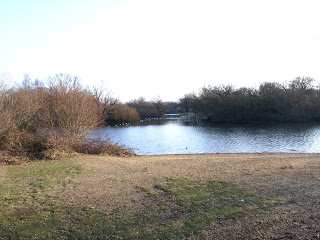
I did not have to go far to find something suitable.
Or something more idyllic?
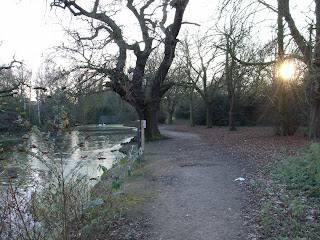
The next scene requires something slightly different.
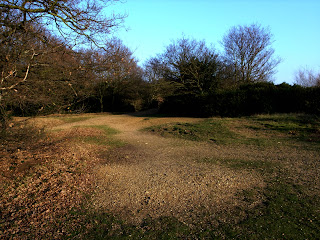
You can see Claire on a slights rise, looking down towards Nick.
He is close to the water we saw at the edge of the frame in the previous scene.

So it would not be difficult to create the impression of the best London weekend.
Now a very different scene.

Now imagined something different for this scene. I suppose I thought the park might be more manicured. More paved pathways than these mud paths, but I really don't know why, or if it was important.

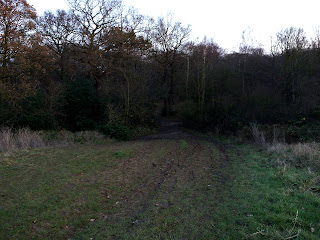

Well, this is only the beginning. I need to go back and find that other location. And there a few other things too. More after Christmas.
I was looking for locations for Claire, revolving around parks. Come to think of it, Paul's story, which I am rewriting at the same time, has a number of park scenes as well.
There are three scenes in the story to do with parks.
15. Out of focus, at a distance, the coloured lights of people and life. A pub or restaurant at night.So this requires a park close-by a roadway with shops and a bar or pub or restaurant. I was going to say that I couldn't find a location like this on Sunday but actually I never even looked for such a place. It will have to wait until after Christmas.
Claire on a park bench. Nearby, Nick. He listens, betraying nothing. He is neutral, or defensive.
18. A bed of flowers. Brilliant sunshine. Kew Gardens. A rush of leaves above, a set of trees around a pond.So this scenes requires one location, by the water, and abundant flowers and trees nearby.
Claire on her back, eyes closed, taking this in. A weekend of sun is a rarity in London. A great aid to the fabrication.
She looks to her right. Nick is there, a blank expression on his face.
I did not have to go far to find something suitable.

Or something more idyllic?

The next scene requires something slightly different.
19. Nick in the distance. By the Thames. He turns and smiles at Claire. She forces a smile in return

You can see Claire on a slights rise, looking down towards Nick.
He is close to the water we saw at the edge of the frame in the previous scene.

So it would not be difficult to create the impression of the best London weekend.
Now a very different scene.
27 She runs across the street and goes into the park.
Once past the trees there is a slight rise and paths go out in three different directions. From this vantage point one can see quite a distance. She looks for him, to confirm he was there, but she can see no one, on any of the paths.

Now imagined something different for this scene. I suppose I thought the park might be more manicured. More paved pathways than these mud paths, but I really don't know why, or if it was important.


Well, this is only the beginning. I need to go back and find that other location. And there a few other things too. More after Christmas.
Monday, December 10, 2007
The pan and the colour of it all
I have already posted about casting for a Claire, but that is not all I have been busy with.
I have also begun writing a new version of the one of the other parts of Tidal Barrier, Paul. I want to post about that latter, when some of the thoughts and ideas are better formed.
I have also been thinking about the visual language. Two weeks ago my friend David, the photographer came over to the flat. He had offered to develop the shooting style. I decided it would be interesting to examine one idea, that of the pan that occurs near the beginning of Claire.
The pan that I described is the only time the camera move in the whole of Claire's story. It seemed important that I understand why. And David was going to help me develop it further.
First David wondered if a pan should not introduce each part, that is Sophie, Claire and Paul, or any significant part, so that it is a part of the language of the film. And also that the pan should be organic to the scene and that we should start by finding potential organic starting points. In my flat, which consists of one long box, and is ideal for home cinema, we have given the space some structure by hanging curtains and dividing the room into three spaces. So we placed the camera near the one set curtains to begin. The curtain material was interesting, as from a distance they were opaque, but close-up, where we set the camera there were fine holes, where light and shadow could be seen. So the camera panned from black, to the macro-view of the curtain, and panned across from complete black, to a close-up of the curtain, which were like stars, with the orange light shining through the fine holes, to the space and Claire then, listening, or rather not listening, as Paul berates her for not truly being there.
From this it seemed important that experiment with other pans in Claire's story, where the camera seems to catch Claire at some activity, by chance. So imagine again the camera in a hallway, panning from black, to a doorways, and walls, into a room, where Claire seems to slip into the frame. Or beginning the same again, but at the end instead capturing the back or Claire as she enters a room, shutting the door behind her.
Is that what the pans meant, catching something unawares, unprepared? Is this distinct to those static shots, which seemed were predetermined to capture all?
There were also some images that I was unsure of, especially in the first scene, where it seems too complicated and confused.
I also played on this idea, in two other scenes in the same park at night, when Claire first meets Nick, and just before the scene above, when she sends Nick away.
David began thinking of achieving this image again inside the flat, with reflections and shadows, growing out of the place and the actions.
But looking back on the idea I wonder if it is just confusing because we have Claire seeing stars, being part of a star scape, and then not seeing stars, seeing a blank, a nothing, being a part of a blank, but no clear idea of why the distinction happens except at the end.
What else? Well David was interested in the quality of the light the camera might come across in the pans, or where a practical light burst on. Would there be a colour or colours? Could these colours then form part of a colour mood of the scene we are moving to? The bedside lamp is red so there is a red light in the space and a red mood in the scene. But why red, or green or yellow? So suddenly art direction seemed so much more critical than it has done. Of course the main reason it hasn't been up to this point is the size of the budget and the lack of an art director.
Well, this is just the beginning. I am hoping to meet up with JC soon and continue the experiments, and with David too, who lives close to Epping Forest, where we might be able to shoot the summer weekend scene.
I have also begun writing a new version of the one of the other parts of Tidal Barrier, Paul. I want to post about that latter, when some of the thoughts and ideas are better formed.
I have also been thinking about the visual language. Two weeks ago my friend David, the photographer came over to the flat. He had offered to develop the shooting style. I decided it would be interesting to examine one idea, that of the pan that occurs near the beginning of Claire.
And then the camera pans across what may be a rooftops and then it is black. This is a wipe.I suppose my question was simply, did it mean anything? I often add something instinctively, then spend a great deal of sweat and tears trying to figure out what it means.
The pan that I described is the only time the camera move in the whole of Claire's story. It seemed important that I understand why. And David was going to help me develop it further.
First David wondered if a pan should not introduce each part, that is Sophie, Claire and Paul, or any significant part, so that it is a part of the language of the film. And also that the pan should be organic to the scene and that we should start by finding potential organic starting points. In my flat, which consists of one long box, and is ideal for home cinema, we have given the space some structure by hanging curtains and dividing the room into three spaces. So we placed the camera near the one set curtains to begin. The curtain material was interesting, as from a distance they were opaque, but close-up, where we set the camera there were fine holes, where light and shadow could be seen. So the camera panned from black, to the macro-view of the curtain, and panned across from complete black, to a close-up of the curtain, which were like stars, with the orange light shining through the fine holes, to the space and Claire then, listening, or rather not listening, as Paul berates her for not truly being there.
From this it seemed important that experiment with other pans in Claire's story, where the camera seems to catch Claire at some activity, by chance. So imagine again the camera in a hallway, panning from black, to a doorways, and walls, into a room, where Claire seems to slip into the frame. Or beginning the same again, but at the end instead capturing the back or Claire as she enters a room, shutting the door behind her.
Is that what the pans meant, catching something unawares, unprepared? Is this distinct to those static shots, which seemed were predetermined to capture all?
There were also some images that I was unsure of, especially in the first scene, where it seems too complicated and confused.
In the background, out there, pinned to a fence or hung on a roof, are those fairly lights? It is hard to tell. Out of focus, seen through a rain soaked window, they are like stars.I wanted to refer to stars, to tie one of the final images together, where Claire, having sent Nick away, searches for some way out, an answer to that question.
She lies down in the grass and looks from the trees up to the stars. She scans and scans.So here I have played against the romantic notion of looking up to the stars. If you go up to Parliament Hill on Hampstead Heath on a clear night you will couples sitting, holding hands, looking up to the heavens. But Claire is alone, and she sees nothing.
But it is overcast and all there is undifferentiated gray. A nothing. No relief anywhere.
I also played on this idea, in two other scenes in the same park at night, when Claire first meets Nick, and just before the scene above, when she sends Nick away.
Out of focus, at a distance, the coloured lights of people and life.Here it is some imagined life and relationships that other people seemingly lead, but which is out of reach of Claire.
David began thinking of achieving this image again inside the flat, with reflections and shadows, growing out of the place and the actions.
But looking back on the idea I wonder if it is just confusing because we have Claire seeing stars, being part of a star scape, and then not seeing stars, seeing a blank, a nothing, being a part of a blank, but no clear idea of why the distinction happens except at the end.
What else? Well David was interested in the quality of the light the camera might come across in the pans, or where a practical light burst on. Would there be a colour or colours? Could these colours then form part of a colour mood of the scene we are moving to? The bedside lamp is red so there is a red light in the space and a red mood in the scene. But why red, or green or yellow? So suddenly art direction seemed so much more critical than it has done. Of course the main reason it hasn't been up to this point is the size of the budget and the lack of an art director.
Well, this is just the beginning. I am hoping to meet up with JC soon and continue the experiments, and with David too, who lives close to Epping Forest, where we might be able to shoot the summer weekend scene.
Saturday, December 01, 2007
Casting update and more
It has been more than two weeks since I last posted. I think I have spent most of the contacting actors, arranging to meet them, and then rearranging meetings.
But it has been a very good experience. I have overcome my initial apprehensions and found that I have got a lot out of the audition process that I developed.
What is the process? Well, I suppose I need to know two things. What does this person look like on camera? How do they move? How are they still? Can they contain this character when there is no one around to observer them?
And the other thing is how the actor thinks. Do they grasp what I have given them in the script and then can they take it further.
So after speaking to them, explaining how I am developing the story, it's part in the feature, and the shooting process we stand up and we shoot Scene 17. This is a scene where Claire, having moved into her sister Natalie's flat, has essentially taken on Natalie's life.
So far,I have met some really great people, who have already contributed to the development of the story. I won't be able to use all of these people, but I feel like I have expanded my circle of available talent for the future.
And while I am waiting to meet new people I have begun to work on the next part of the feature, Paul's story. More on that to come.
But it has been a very good experience. I have overcome my initial apprehensions and found that I have got a lot out of the audition process that I developed.
What is the process? Well, I suppose I need to know two things. What does this person look like on camera? How do they move? How are they still? Can they contain this character when there is no one around to observer them?
And the other thing is how the actor thinks. Do they grasp what I have given them in the script and then can they take it further.
So after speaking to them, explaining how I am developing the story, it's part in the feature, and the shooting process we stand up and we shoot Scene 17. This is a scene where Claire, having moved into her sister Natalie's flat, has essentially taken on Natalie's life.
So far,I have met some really great people, who have already contributed to the development of the story. I won't be able to use all of these people, but I feel like I have expanded my circle of available talent for the future.
And while I am waiting to meet new people I have begun to work on the next part of the feature, Paul's story. More on that to come.
Sunday, November 18, 2007
Abstract images and Haneke
The other night I decided to watch Haneke's The 7th Continent again. Based on a true story, a typical middle-class Austrian family find life does not offer anything more than a series of an emotionally-empty, mundane events. They decide to destroy their lives and commit suicide (yep, not the most upbeat of stories). The 7th Continent refers to Australia, but in an abstract sense, a image of another world, perhaps where what is missing in their lives will be fulfilled? It is probably not that simple.
(In the film, when their bank asks them what they need all their money for they tell them they are emigrating to Australia.)
This image Haneke represents with an impossibly beautiful visual of a beach with waves crashing against the shore. The picture is so artificial it is almost becomes disturbing in its own right, and I would guess that if this image is what the family believes is missing in their lives then Haneke is saying this too is false.
Well, I had forgotten all about this picture when I was discussing my questions of the 'blackouts + sound' these past few weeks. Of course this picture acts in the way that I intend my blackouts to work, as an abstraction of a state, expressed at key points in the film. I can't remember if I had already said that JC, my DOP, thought these blackouts would act as an alienation effect, that the audience would suddenly be made aware of their presence in the cinema. This is not to say this is good or bad, just what would happen. But now, after seeing The 7th Continent again I have to think that this is not the case. Or perhaps in a conventional film this would be the case. In film structures like Haneke's, or what I am attempting to pull off in Tidal Barrier, these abstract images act in another way.
(In the film, when their bank asks them what they need all their money for they tell them they are emigrating to Australia.)
This image Haneke represents with an impossibly beautiful visual of a beach with waves crashing against the shore. The picture is so artificial it is almost becomes disturbing in its own right, and I would guess that if this image is what the family believes is missing in their lives then Haneke is saying this too is false.
Well, I had forgotten all about this picture when I was discussing my questions of the 'blackouts + sound' these past few weeks. Of course this picture acts in the way that I intend my blackouts to work, as an abstraction of a state, expressed at key points in the film. I can't remember if I had already said that JC, my DOP, thought these blackouts would act as an alienation effect, that the audience would suddenly be made aware of their presence in the cinema. This is not to say this is good or bad, just what would happen. But now, after seeing The 7th Continent again I have to think that this is not the case. Or perhaps in a conventional film this would be the case. In film structures like Haneke's, or what I am attempting to pull off in Tidal Barrier, these abstract images act in another way.
Tuesday, November 13, 2007
Casting for Claire
I am closing to finishing Reconciliation, which will be a great relief. It is hard to focus on the new project when you are preoccupied with the practical problems of sound design and grading.
Still, this past weekend I sent out a casting call for the character, Claire, in Tidal Barrier. A week from today I will begin to meet some new actresses.
There are so many reasons I find casting difficult. First, there are so many conventions that I find pointless. Most actors expect to have to prepare and present something. The last thing I am interested in seeing is a Shakespeare monologue. What's that got to do with my script? I suppose the real test is how they react when I throw out the rule book.
The other big question is how they react to a lack of a script. I work from an outline. What do I need a script for? It is a document for producers, so they can't calculate running time and create budgets. There is no budget. And we will be shooting the whole story on DV and editing it. I will have the clearest possible idea of running time and production problems from this exercise.
And there is no dialogue either, the other reason you create a script. So no script, another real test.
And then what do you have them do? In the past I spent a lot of time talking. Finding out about the person and trying to gauge where this person is a capable of going. At the same time you are seeing them react and be, and you capture this on camera.
But recently I have been less inclined to speak, and more inclined to do, and capture the scene on video. Here I interested how they can be on camera, where they can start from, and where they can go, eg. take direction. I am really looking to see how effectively I can get them to not act.
Still, this past weekend I sent out a casting call for the character, Claire, in Tidal Barrier. A week from today I will begin to meet some new actresses.
There are so many reasons I find casting difficult. First, there are so many conventions that I find pointless. Most actors expect to have to prepare and present something. The last thing I am interested in seeing is a Shakespeare monologue. What's that got to do with my script? I suppose the real test is how they react when I throw out the rule book.
The other big question is how they react to a lack of a script. I work from an outline. What do I need a script for? It is a document for producers, so they can't calculate running time and create budgets. There is no budget. And we will be shooting the whole story on DV and editing it. I will have the clearest possible idea of running time and production problems from this exercise.
And there is no dialogue either, the other reason you create a script. So no script, another real test.
And then what do you have them do? In the past I spent a lot of time talking. Finding out about the person and trying to gauge where this person is a capable of going. At the same time you are seeing them react and be, and you capture this on camera.
But recently I have been less inclined to speak, and more inclined to do, and capture the scene on video. Here I interested how they can be on camera, where they can start from, and where they can go, eg. take direction. I am really looking to see how effectively I can get them to not act.
Tuesday, October 30, 2007
Blackouts and the 7th draft
Okay, so I have finished the new draft two weeks ago and what have I done since then? Nothing. I suppose I am preoccupied in finishing off the short, Reconciliation, but I also wanted some distance from it before I look at it again.
Then I realised how little I have said about it. I have discussed so many different problems and ideas, such as sound as particular narrative element, Claire's image and blackouts.
So the new draft incorporates 3 or 4 blackouts.
What do they mean? I struggle to explain them, or understand myself. Perhaps if I describe them...?
First, all of these come out of the narrative. That is, there is a logic to their placement. The first comes about as the camera pans across the rooftops and is blocked by...we don't know what, but it is black.
The second from last, and the longest blackout could be interpreted as Claire's POV, as she sits on a park bench speaking to Nick, with her eyes shut, and she hears...? So I could say that they are Claire's view (I am a long way from deciding if they will form a part of the other stories), or better, are a part of Claire, or an expression of Claire's. The makes sense especially in the final scene, after she has ended it with Nick. She scans the sky, looking for an opening, but finds nothing. Then there is the moment of recognition, the iconic look. And then the black. Here it might be that Claire has accepted the black as expression of her true self?
Then I think I contradict all of this by adding sound. I think I have already said that the blackouts here function differently than those I used in Reconciliation in that in the short film they were punctuation for the scene previous and the scene to follow. In Tidal Barrier - Claire, the blackouts are scenes themselves, and the sound is the content. The image I return to in each:
When she takes up her new life at Natalie's she looks into every corner of the flat, even to the extent of climbing up on a ladder to see what is hidden on the top of the bookshelves. Here she feels a breeze coming in an open window, and inhales. What is that she can smell? Later, with Nick, she tries to convince him to experience it with her, and that the odour was the Thames. Nick is having none of it. The Thames is a long way off, and anyway it doesn't have it's own odour, or at least not a pleasant one.
So looking back at this, are the blackouts, the sound scape and Claire's image one and the same?
Then I realised how little I have said about it. I have discussed so many different problems and ideas, such as sound as particular narrative element, Claire's image and blackouts.
So the new draft incorporates 3 or 4 blackouts.
What do they mean? I struggle to explain them, or understand myself. Perhaps if I describe them...?
First, all of these come out of the narrative. That is, there is a logic to their placement. The first comes about as the camera pans across the rooftops and is blocked by...we don't know what, but it is black.
The second from last, and the longest blackout could be interpreted as Claire's POV, as she sits on a park bench speaking to Nick, with her eyes shut, and she hears...? So I could say that they are Claire's view (I am a long way from deciding if they will form a part of the other stories), or better, are a part of Claire, or an expression of Claire's. The makes sense especially in the final scene, after she has ended it with Nick. She scans the sky, looking for an opening, but finds nothing. Then there is the moment of recognition, the iconic look. And then the black. Here it might be that Claire has accepted the black as expression of her true self?
Then I think I contradict all of this by adding sound. I think I have already said that the blackouts here function differently than those I used in Reconciliation in that in the short film they were punctuation for the scene previous and the scene to follow. In Tidal Barrier - Claire, the blackouts are scenes themselves, and the sound is the content. The image I return to in each:
If the Thames could roar or rush, this is the sound it would make.And this sound is again tied back to Claire and the story in two scenes.
When she takes up her new life at Natalie's she looks into every corner of the flat, even to the extent of climbing up on a ladder to see what is hidden on the top of the bookshelves. Here she feels a breeze coming in an open window, and inhales. What is that she can smell? Later, with Nick, she tries to convince him to experience it with her, and that the odour was the Thames. Nick is having none of it. The Thames is a long way off, and anyway it doesn't have it's own odour, or at least not a pleasant one.
So looking back at this, are the blackouts, the sound scape and Claire's image one and the same?
Monday, October 22, 2007
The seventh draft/the first draft?
I am not sure. I feel that I have begun again with the script, found so much clarity, it doesn't feel like the same script. And, most telling, it has taken me approximately two weeks to complete.
So it is done, I am ready to send it out. I am happy to make some revisions for clarity, but I believe that I will really find the film in the workshop, which will start in November. As the Reconciliation projection winds itself up (I have posted in my other blog about my reaction to the first cut of the sound design) I will begin the hunt for actors to take part.
My plan again: working with the actors, probably in my own flat for the most part, I will shoot the whole film on DV, edit it, and revise again (that is shooting), until I am happy. Then to film.
So it is done, I am ready to send it out. I am happy to make some revisions for clarity, but I believe that I will really find the film in the workshop, which will start in November. As the Reconciliation projection winds itself up (I have posted in my other blog about my reaction to the first cut of the sound design) I will begin the hunt for actors to take part.
My plan again: working with the actors, probably in my own flat for the most part, I will shoot the whole film on DV, edit it, and revise again (that is shooting), until I am happy. Then to film.
Friday, October 12, 2007
Robert Bresson at the NFT
If you have never seen a Robert Bresson film, or even if you have, don't miss out on the retrospective at the NFT this month.
http://www.bfi.org.uk/whatson/southbank/seasons/bresson/
What is amazing is the list of films and filmmakers who have been influenced by Bresson.
http://www.bfi.org.uk/whatson/southbank/seasons/bresson/
What is amazing is the list of films and filmmakers who have been influenced by Bresson.
Revision begins
So I have booked myself off this weekend - I intend to call or speak to no one.
I need my head clear to rewrite the Tidal Barrier - Claire.
I began tonight and have been quite happy with my progress.
I have set a goal to finish the rewrites by the end of October.
Tonight, some great discoveries and re-discoveries.
In the workshop so long ago the actress Helen, pointed out a flaw (or not, depending on the choice) in the story: Natalie reports that Nick is obsessed with her, which leads Claire to find him so she may experience this kind of feeling. But when she is with him he is anything but obsessive. he is actually quite nice. This may be a choice, that he cannot become fixated upon Claire because of who she is.
The other choice, to rewrite the story so that his behaviour is obsessive, but turns out to be hollow and empty. A game. That his life is as empty as Claire's.
I have opted for the latter.
I need my head clear to rewrite the Tidal Barrier - Claire.
I began tonight and have been quite happy with my progress.
I have set a goal to finish the rewrites by the end of October.
Tonight, some great discoveries and re-discoveries.
In the workshop so long ago the actress Helen, pointed out a flaw (or not, depending on the choice) in the story: Natalie reports that Nick is obsessed with her, which leads Claire to find him so she may experience this kind of feeling. But when she is with him he is anything but obsessive. he is actually quite nice. This may be a choice, that he cannot become fixated upon Claire because of who she is.
The other choice, to rewrite the story so that his behaviour is obsessive, but turns out to be hollow and empty. A game. That his life is as empty as Claire's.
I have opted for the latter.
Wednesday, October 03, 2007
San Sebastian
Well here it is, yet another photo of one of the bays in San Sebastian. Just from this you can imagine this is a great location for a film festival, but I can also vouch for the food which was wonderful, and the drink was which was not only amazing but generous.

As for the films? As you can imagine at a festival with a programme to support 1st time directors and students as well, some of the films were very weak, some very good. I think that having a film here would be certainly be an accomplishment, and I would like to see if they might have an interest in Tidal Barrier. The only problem I can see is that this festival quite naturally focuses on Spanish-speaking cinema.
More photos:

]
David, when he wasn't in the cinema with me, was taking photographs. He is after all, a photographer. And he was taken with the light.

James, on the other hand, spent most of this time on the phone. He had a girlfriend in New York.
As for the script? I have begun the new draft.

As for the films? As you can imagine at a festival with a programme to support 1st time directors and students as well, some of the films were very weak, some very good. I think that having a film here would be certainly be an accomplishment, and I would like to see if they might have an interest in Tidal Barrier. The only problem I can see is that this festival quite naturally focuses on Spanish-speaking cinema.
More photos:

]
David, when he wasn't in the cinema with me, was taking photographs. He is after all, a photographer. And he was taken with the light.

James, on the other hand, spent most of this time on the phone. He had a girlfriend in New York.
As for the script? I have begun the new draft.
Monday, September 24, 2007
September update
While I have been busy with the short film I have managed to continue the feature.
Today at work, having little else to do, I began the next draft of Tidal Barrier - Claire.
On a more practical note I am in the middle of buying one of these:

This is a used Aaton LTR54 with a set of primes. Buying one of these has a way of forcing the issue. I will have to make that feature now.
And on Wednesday I am off to San Sebastian, Spain, for the film festival. I am quite excited as Mark Peploe, who wrote The Passenger with Antonioni, is on the jury. With accreditation and a lot of schmoozing perhaps I will get to meet him.
The festival has a remit to highlight first time directors so I will be looking to see if they might one day be interested in Tidal Barrier.
I will try to send some photos in the coming week.
Today at work, having little else to do, I began the next draft of Tidal Barrier - Claire.
On a more practical note I am in the middle of buying one of these:

This is a used Aaton LTR54 with a set of primes. Buying one of these has a way of forcing the issue. I will have to make that feature now.
And on Wednesday I am off to San Sebastian, Spain, for the film festival. I am quite excited as Mark Peploe, who wrote The Passenger with Antonioni, is on the jury. With accreditation and a lot of schmoozing perhaps I will get to meet him.
The festival has a remit to highlight first time directors so I will be looking to see if they might one day be interested in Tidal Barrier.
I will try to send some photos in the coming week.
Thursday, September 13, 2007
Quick update
Just a quick note to explain my silence: I am busy preparing to do some pickups for the short film project, Reconciliation.
I have not neglected thinking about Tidal Barrier. Of late I have been looking at Mizoguchi, who was the master of the one-shot/one scene. More on this in the coming weeks.
I have not neglected thinking about Tidal Barrier. Of late I have been looking at Mizoguchi, who was the master of the one-shot/one scene. More on this in the coming weeks.
Tuesday, September 04, 2007
Rounding the image
Okay, perhaps I have it now. That is, finding a way to round the images in Tidal Barrier - Claire.
We open with sky, covered in gray cloud (repeated in the final scene). This seen through a window or a skylight. It is raining, or it could rain.
A man speaking to someone. We cannot see him yet.
Then Claire, looking up at this window or skylight (we repeat this image at the end and in the middle of the story).
The man continues. We still cannot seem him, or perhaps we see a fragment of him at the edge of frame. It is all about what she hasn't not done, or hasn't been.
But Claire says nothing. Just looks up.
Finally he can take it no longer. he stands, takes her hand, pulls her arm, demands her attention. This is what he means. This is just it.
And she looks at him for the first time.
He is going to leave now.
Now a window. Water drops working their way down the glass.
In the background, out there, pinned to a fence or hung on a roof, are those fairly lights? It is hard to tell. Out of focus, seen through a rain soaked window, they could be stars.
And then the camera pans across what may be a rooftops and then what is that? A chimney? A wall? Whatever is, it is black. This is a wipe.
In the dark, sounds. We can't know what they are.
And then we are back. That same view across rooftops, across London. At some distance a light flashing, warning (as the light Claire sees on the roadway just before the final scene). And perhaps that is the Thames in the distance.
Then Claire, through this window. The fairy lights reflected on the glass, all over her. She should be looking at this scene but she is not really seeing anything. A glassy-eyed stare.
Black. Titles.
We open with sky, covered in gray cloud (repeated in the final scene). This seen through a window or a skylight. It is raining, or it could rain.
A man speaking to someone. We cannot see him yet.
Then Claire, looking up at this window or skylight (we repeat this image at the end and in the middle of the story).
The man continues. We still cannot seem him, or perhaps we see a fragment of him at the edge of frame. It is all about what she hasn't not done, or hasn't been.
But Claire says nothing. Just looks up.
Finally he can take it no longer. he stands, takes her hand, pulls her arm, demands her attention. This is what he means. This is just it.
And she looks at him for the first time.
He is going to leave now.
Now a window. Water drops working their way down the glass.
In the background, out there, pinned to a fence or hung on a roof, are those fairly lights? It is hard to tell. Out of focus, seen through a rain soaked window, they could be stars.
And then the camera pans across what may be a rooftops and then what is that? A chimney? A wall? Whatever is, it is black. This is a wipe.
In the dark, sounds. We can't know what they are.
And then we are back. That same view across rooftops, across London. At some distance a light flashing, warning (as the light Claire sees on the roadway just before the final scene). And perhaps that is the Thames in the distance.
Then Claire, through this window. The fairy lights reflected on the glass, all over her. She should be looking at this scene but she is not really seeing anything. A glassy-eyed stare.
Black. Titles.
Wednesday, August 29, 2007
I struggle with this image
I continue to work on notes for the new script.
I feel comfortable with most everything - that is comfortable enough to hold a workshop with actors - but for one element: an image for Claire. One that is personal to her, she takes part in. I mean in contrast to an image of which she has a passive role, the way that Antononi would put his actors in a landscape or in front of a building.
I always look back to Kieslowski, specifically The Double Life of Veronique, where Veronika carries with her a clear marble from which she observes the world, fish-eyed and turned upside down. This idea is repeated when she watches her father at work, seen from behind, through the thick lenses of his spectacles.
Veronika's glass is a habit, part of her. Is this what I am looking for?
In Blue, which I watched again for the 15th time, Julie has her habits too, though not objects. Instead we see that well-known image of her dissolving sugar in her coffee. Kieslowski went to a great deal of trouble finding a sugar cube that would absorb liquid in a given amount of time. And what did he say about it? That for him it was about Julie looking inward. Self-absorbed. And she is, considering what has happened to her. For Kieslowski abstractions are just that, abstracted, taken from the real. Is this what I am looking for? Do I need to sit with the actor and work and find that image?
But I am looking also to use this image to tie together some other images. The final scene, with Claire on the ground of the park, staring up at the sky, looking for an opening, some understanding.
Claire exploring her sister's flat, trying to know it intimately, standing on a ladder, looking over the top of the bookshelves, and there thinking that she can smell the Thames. Water.
So here I am at the beginning of the story trying to say something about Claire and her relationship and all this too. It is too much.
I feel comfortable with most everything - that is comfortable enough to hold a workshop with actors - but for one element: an image for Claire. One that is personal to her, she takes part in. I mean in contrast to an image of which she has a passive role, the way that Antononi would put his actors in a landscape or in front of a building.
I always look back to Kieslowski, specifically The Double Life of Veronique, where Veronika carries with her a clear marble from which she observes the world, fish-eyed and turned upside down. This idea is repeated when she watches her father at work, seen from behind, through the thick lenses of his spectacles.
Veronika's glass is a habit, part of her. Is this what I am looking for?
In Blue, which I watched again for the 15th time, Julie has her habits too, though not objects. Instead we see that well-known image of her dissolving sugar in her coffee. Kieslowski went to a great deal of trouble finding a sugar cube that would absorb liquid in a given amount of time. And what did he say about it? That for him it was about Julie looking inward. Self-absorbed. And she is, considering what has happened to her. For Kieslowski abstractions are just that, abstracted, taken from the real. Is this what I am looking for? Do I need to sit with the actor and work and find that image?
But I am looking also to use this image to tie together some other images. The final scene, with Claire on the ground of the park, staring up at the sky, looking for an opening, some understanding.
Claire exploring her sister's flat, trying to know it intimately, standing on a ladder, looking over the top of the bookshelves, and there thinking that she can smell the Thames. Water.
So here I am at the beginning of the story trying to say something about Claire and her relationship and all this too. It is too much.
Monday, August 20, 2007
More blackouts
I have been working through Robert Bresson's Notes on the Cinematographer, which has been an inspiration. It just occurred to me that I do not how the notes are organised, but it is logical that they are presented as Bresson discovered them, so as you read you are privy to not only his discovery but the way the discovery came to be.
(And later tonight I will be seeing Mouchette for the first time. )
So I was very excited to come across a section titled Sight and Hearing, considering that I have been thinking on the use of sound in Tidal Barrier/Claire and the concept of blackouts.
First he writes:
Now I realise he is certainly could not have been thinking of my idea to use sound over black, but he might at least consider it a worthwhile experiment. Perhaps too self-conscious? Probably. But perhaps if I develop my idea further it might not seem so formal.
Further along:
Now he seems to articulating I only understood vaguely or instinctively. Perhaps that is what I am getting at? That the sound over black is to be used where we are moving within of the Claire. In her story she finds nothing when she looks at herself. It is bare, and that is why she despairs. So the the sound over black is her discovery of how she is wanting. She tries to reach within by pretending something else, pretending to be someone else and fails. The sound over black then must be the accumulation of sounds which have been articulated previously. So they have a logic, but now become something else, are abstracted by their use over black. So I need to establish these sounds earlier. And the black needs also to be articulated earlier in the literal sense. That is I need to show at least briefly black as part of the narrative. So imagine we cut to black. We can make out nothing. The sound of her breathing (we won't know it is her for a time), perhaps the ticking of a clock, and then something else, something odd. A light comes on. It is the bedside lamp. She has been sleeping and has heard this same sound and is now frightened.
But even before that I can imagine using black near the beginning of her story, as she hears, but does not listen to Paul's litany of complaints of her lack of commitment. The camera is fixed up on her, who is distracted (not sure of the image here), and then Paul, who we only see in fragments, at the edge of the frame, has had enough. He gets up and goes off and the camera pans with him and finds itself pointing at black (this is the first time I have thought of moving the camera in a long time, and I think it is good to use camera movement so sparingly). And we only hear the sound of her image - still don't know what that is.
If I build these pieces then I may be free to present the black as part of the climax, the articulation of her realisation. My only problem that I can only see this happening right at the end. Of course this is obvious, the climax would come near the end. The problem that by convention this is the black at the end of the film, where the credits would appear. If this story were first then audience would note the oddness of its placement, but if it were later they might just think this was the end.
Well one problem at a time.
(And later tonight I will be seeing Mouchette for the first time. )
So I was very excited to come across a section titled Sight and Hearing, considering that I have been thinking on the use of sound in Tidal Barrier/Claire and the concept of blackouts.
First he writes:
If the eye is entirely won, give nothing or almost nothing to the ear. One cannot be at the same all eye and all ear.
And vice versa, if the ear is entirely won, give nothing to the eye.
Now I realise he is certainly could not have been thinking of my idea to use sound over black, but he might at least consider it a worthwhile experiment. Perhaps too self-conscious? Probably. But perhaps if I develop my idea further it might not seem so formal.
Further along:
When a sound can replace an image, cut the image or neutralize it. The ear goes more towards the within, the eye towards the outer.
Now he seems to articulating I only understood vaguely or instinctively. Perhaps that is what I am getting at? That the sound over black is to be used where we are moving within of the Claire. In her story she finds nothing when she looks at herself. It is bare, and that is why she despairs. So the the sound over black is her discovery of how she is wanting. She tries to reach within by pretending something else, pretending to be someone else and fails. The sound over black then must be the accumulation of sounds which have been articulated previously. So they have a logic, but now become something else, are abstracted by their use over black. So I need to establish these sounds earlier. And the black needs also to be articulated earlier in the literal sense. That is I need to show at least briefly black as part of the narrative. So imagine we cut to black. We can make out nothing. The sound of her breathing (we won't know it is her for a time), perhaps the ticking of a clock, and then something else, something odd. A light comes on. It is the bedside lamp. She has been sleeping and has heard this same sound and is now frightened.
But even before that I can imagine using black near the beginning of her story, as she hears, but does not listen to Paul's litany of complaints of her lack of commitment. The camera is fixed up on her, who is distracted (not sure of the image here), and then Paul, who we only see in fragments, at the edge of the frame, has had enough. He gets up and goes off and the camera pans with him and finds itself pointing at black (this is the first time I have thought of moving the camera in a long time, and I think it is good to use camera movement so sparingly). And we only hear the sound of her image - still don't know what that is.
If I build these pieces then I may be free to present the black as part of the climax, the articulation of her realisation. My only problem that I can only see this happening right at the end. Of course this is obvious, the climax would come near the end. The problem that by convention this is the black at the end of the film, where the credits would appear. If this story were first then audience would note the oddness of its placement, but if it were later they might just think this was the end.
Well one problem at a time.
Tuesday, August 14, 2007
Blackouts
While Reconciliation moves slowly along I have been quite rewriting Tidal Barrier (Claire).
There is a lot to say, so much of it coming from the work on Reconciliation, and I am very excited about where it is going.
More on that soon, but first about the blackouts.
I have found it very exciting how they have worked in Reconciliation. 1 second blackouts between scenes. I cannot describe the effect, except that in the first and second instances they are a bit of a shock, and then one begins to want them, expect them. It would be odd if they stopped. It is all about rhythm.
So now I am thinking of something different. Longer blackouts that are themselves elements of the story. There length would vary, but would be at least be 15 seconds long. For practical purposes the first would need to arrive early in the story so people would not confuse it with the end of the film. Sound? Perhaps that is why they would be there (in Reconciliation it seemed that they must be silent). I can see that they are part of the soundscape, and this is becoming critical to the story. As I remove dialogue sound is freed, can become its own element. The blackouts could support both abstract and real sounds.
There is a lot to say, so much of it coming from the work on Reconciliation, and I am very excited about where it is going.
More on that soon, but first about the blackouts.
I have found it very exciting how they have worked in Reconciliation. 1 second blackouts between scenes. I cannot describe the effect, except that in the first and second instances they are a bit of a shock, and then one begins to want them, expect them. It would be odd if they stopped. It is all about rhythm.
So now I am thinking of something different. Longer blackouts that are themselves elements of the story. There length would vary, but would be at least be 15 seconds long. For practical purposes the first would need to arrive early in the story so people would not confuse it with the end of the film. Sound? Perhaps that is why they would be there (in Reconciliation it seemed that they must be silent). I can see that they are part of the soundscape, and this is becoming critical to the story. As I remove dialogue sound is freed, can become its own element. The blackouts could support both abstract and real sounds.
Tuesday, August 07, 2007
A proposal for a formal approach - II
I just managing to keep my two projects together in my head.
From the editing of Reconciliation I have been pushing along of my formal principles: limiting dialogue to the absolute minimum. By dialogue I mean an exchange of words between two characters, and that these words act as a narrative element. In Reconciliation I have a character speaking on the phone, but we only hear his part of the conversation, and the words are not a narrative element.
I have been encouraged how far I was able to take this. The short film now has two lines of dialogue.
Of course it comes down not having a narrative that needs dialogue to support it. In my last draft of Tidal Barrier I had these long dialogue sequences between Sophie and Claire and absolutely hated them. Now I am starting to see what is essential in the these scenes and I am able to comfortably excise the rest. The characters may have words, and some of it may come to dialogue, but the minimum. I have found I am able to reduce three-pages of dialogue to a sequence of shots, and one question. In these sequences I have found freedom.
And more, the end of dialogue has meant that now I am better able to see how sound how can shape the story in a fundamental way.
My last great insight from Reconciliation is about the blackouts. For next time.
From the editing of Reconciliation I have been pushing along of my formal principles: limiting dialogue to the absolute minimum. By dialogue I mean an exchange of words between two characters, and that these words act as a narrative element. In Reconciliation I have a character speaking on the phone, but we only hear his part of the conversation, and the words are not a narrative element.
I have been encouraged how far I was able to take this. The short film now has two lines of dialogue.
Of course it comes down not having a narrative that needs dialogue to support it. In my last draft of Tidal Barrier I had these long dialogue sequences between Sophie and Claire and absolutely hated them. Now I am starting to see what is essential in the these scenes and I am able to comfortably excise the rest. The characters may have words, and some of it may come to dialogue, but the minimum. I have found I am able to reduce three-pages of dialogue to a sequence of shots, and one question. In these sequences I have found freedom.
And more, the end of dialogue has meant that now I am better able to see how sound how can shape the story in a fundamental way.
My last great insight from Reconciliation is about the blackouts. For next time.
Sunday, July 29, 2007
A proposal for a formal approach - I
As I work my way through the edit of Reconcilation, coming to see the strengths and weaknesses, and worst of all the missed opportunities, I have begun to think of how I might approach Tidal Barrier/Claire.
I think I have already said so long ago that I have subscribed to Tarkovsky's ideal, to build each shot on the shoulders of the last. This implies that each scene or moment or has its ideal shot/ position/angle and the film making process is the struggle to discover it.
This also implies an abandonment of continuity editing, conventional establishing shot to close-up, to reverse close-up, to two-shot, back to the establishing shot. Instead of moving forward continuity editing moves in a circle. Instead of the pure film making pursuit of finding the shot, and then the next, it serves the demands of staging of a scene, which is something Tarkovsky believes was stolen from the theatre, and has no place in film.
Could I have achieved this in Reconciliation? I have already said that I have failed at points in that film (described below), where I have found myself, I feel, going in a circle instead of going forward. But then in the feedback the other night, JC (my cinematographer) suggested an idea that would solve the problem, or could have if we had the footage. I have spent this Sunday deciding if I shoot a pickup.
So, yes, is the short answer.
The best part of rejecting staging and continuity editing? I can already see a place for it in Tidal Barrier/Claire, at the point when her life goes into reverse. Can you imagine the power of the wide shot, then close-up if you have not seen a close-up for 25 minutes?
I think I have already said so long ago that I have subscribed to Tarkovsky's ideal, to build each shot on the shoulders of the last. This implies that each scene or moment or has its ideal shot/ position/angle and the film making process is the struggle to discover it.
This also implies an abandonment of continuity editing, conventional establishing shot to close-up, to reverse close-up, to two-shot, back to the establishing shot. Instead of moving forward continuity editing moves in a circle. Instead of the pure film making pursuit of finding the shot, and then the next, it serves the demands of staging of a scene, which is something Tarkovsky believes was stolen from the theatre, and has no place in film.
Could I have achieved this in Reconciliation? I have already said that I have failed at points in that film (described below), where I have found myself, I feel, going in a circle instead of going forward. But then in the feedback the other night, JC (my cinematographer) suggested an idea that would solve the problem, or could have if we had the footage. I have spent this Sunday deciding if I shoot a pickup.
So, yes, is the short answer.
The best part of rejecting staging and continuity editing? I can already see a place for it in Tidal Barrier/Claire, at the point when her life goes into reverse. Can you imagine the power of the wide shot, then close-up if you have not seen a close-up for 25 minutes?
Sunday, July 22, 2007
What I have learned so far
I am have completed three rough edits of Reconciliation (see my other blog for the latest information) and have become objective enough to see two major weaknesses.
First, a problem that I has come up before: the weakness what has been referred to in Ozu as codas, those static shots, inserted between scenes. Kieslowski did something else. He often used objects, which became extensions of scenes or characters. Think of the glass ball which Veronka plays with in The Double Life of Veronique, or the fabulous cube of sugar in the cafe in Blue. In Reconciliation the results have not been very strong and seems it is down to the fact that I am not able to communication what is required and how critical these shots are. Perhaps one of the problems is that they are called inserts in the film industry here, which makes them an afterthought. I am uncertain how to solve the problem.
Secondly, I have found that I was not as successful as I would have liked in developing the shots in the in Scene 5. Remember, one of the experiments was to develop the story with successive shots, never returning to the same shot, such as the establishing shot as you would in continuity editing. In Scene 5 he is in the kitchen talking on the phone. This is 5A, a medium close-up.

At one point he bumps into some pots and looks off. Then we cut to her in the living room. This is 5B, a medium shot.

We hear him in the background, still on the phone, as she tries to read a magazine without much success. Finally she gives up, goes into the kitchen and retrieves the vacuum cleaner, he still on the phone. I went wider on the last shot. This is 5C.

Looking at these shots now it seems that shots don't succeed each other. There is not enough of a difference between 5A and 5C. It feels we are going backwards. Now this is not a matter of the shots or angles, but rather the script: For him 5C is a continuation of 5A. A weakness of the script.
First, a problem that I has come up before: the weakness what has been referred to in Ozu as codas, those static shots, inserted between scenes. Kieslowski did something else. He often used objects, which became extensions of scenes or characters. Think of the glass ball which Veronka plays with in The Double Life of Veronique, or the fabulous cube of sugar in the cafe in Blue. In Reconciliation the results have not been very strong and seems it is down to the fact that I am not able to communication what is required and how critical these shots are. Perhaps one of the problems is that they are called inserts in the film industry here, which makes them an afterthought. I am uncertain how to solve the problem.
Secondly, I have found that I was not as successful as I would have liked in developing the shots in the in Scene 5. Remember, one of the experiments was to develop the story with successive shots, never returning to the same shot, such as the establishing shot as you would in continuity editing. In Scene 5 he is in the kitchen talking on the phone. This is 5A, a medium close-up.

At one point he bumps into some pots and looks off. Then we cut to her in the living room. This is 5B, a medium shot.

We hear him in the background, still on the phone, as she tries to read a magazine without much success. Finally she gives up, goes into the kitchen and retrieves the vacuum cleaner, he still on the phone. I went wider on the last shot. This is 5C.

Looking at these shots now it seems that shots don't succeed each other. There is not enough of a difference between 5A and 5C. It feels we are going backwards. Now this is not a matter of the shots or angles, but rather the script: For him 5C is a continuation of 5A. A weakness of the script.
Sunday, July 15, 2007
New film by Tsai Ming-Liang
One of my favourite new directors has a new film out, I Don't Want to Sleep Alone, this Wednesday at the Barbican (http://www.barbican.org.uk/film/event-detail.asp?ID=4349). If you are not familiar with his films, I highly recommend them. My favourites include The Hole, What time is it there? and Goodbye Dragon Inn.
Here is a great example of someone who ignores the conventions of continuity editing. I don't think I have ever seen a close-up in any of his films. The camera remains at a distance, in long-shot or medium-shot, detached, observing.
This is a man not afraid to take the lengthy shot to the extreme. I especially remember the cinematography and sound in Goodbye Dragon Inn - a proper sound system is a must.
Here is a great example of someone who ignores the conventions of continuity editing. I don't think I have ever seen a close-up in any of his films. The camera remains at a distance, in long-shot or medium-shot, detached, observing.
This is a man not afraid to take the lengthy shot to the extreme. I especially remember the cinematography and sound in Goodbye Dragon Inn - a proper sound system is a must.
Thursday, July 05, 2007
Looking again at Part 2 - Claire (-Paul)
So, I am waiting to begin editing my short film, Reconciliation (I am trying to get a deal on a transfer to hard drive and waiting for some parts from the US), and so I am beginning to rewrite the Tidal Barrier project, with the focus on Part 2/Claire. Why? I suppose this part is the most complete and clearest. I have some ideas how to make the other parts work, but Part 2 is close enough. I am hoping that making this part first will give me more confidence for the other parts.
Revisiting the outline, I was struck by a few things.
I still feel that it is missing that one strong, central image. I think it is there, obscured by plot, or psychology.
The weakest scenes were those that were (too) cleverly making connections to the other parts of the script. It would be simpler and stronger to keep to the main thrust of the story.
This also means there are too many location. Making it simpler means it will be cheaper to make.
So what next?
A revision of the script, and then a workshop, as I did with Reconciliation, shot and edited onto DV. More revisions and workshopping, with an aim to shoot the real thing in November.
Revisiting the outline, I was struck by a few things.
I still feel that it is missing that one strong, central image. I think it is there, obscured by plot, or psychology.
The weakest scenes were those that were (too) cleverly making connections to the other parts of the script. It would be simpler and stronger to keep to the main thrust of the story.
This also means there are too many location. Making it simpler means it will be cheaper to make.
So what next?
A revision of the script, and then a workshop, as I did with Reconciliation, shot and edited onto DV. More revisions and workshopping, with an aim to shoot the real thing in November.
Monday, June 25, 2007
Forward thinking...
So I have started to formulate a plan to begin shooting the feature in November. Only a year late! From shooting Reconcilation I began to see the weaknesses and the opportunities in the current script: the more I explain, the less compelling the story is. If I remove the explanation, the psychology, I make the story more forward more directly, suggest a shooting style, and make it more practical to shoot on a small budget (fewer locations, fewer actors), etc.
I am thinking that I begin with the second story, that of Claire as she tries to take on her sister's life, and truly change. And fails. I focus more on that empty place she is trying to fill, the transcendental, and less her telling what she is doing. The shooting style is driven by her story, built shot by shot, each leading to the next.
I am thinking that I begin with the second story, that of Claire as she tries to take on her sister's life, and truly change. And fails. I focus more on that empty place she is trying to fill, the transcendental, and less her telling what she is doing. The shooting style is driven by her story, built shot by shot, each leading to the next.
Sunday, June 24, 2007
Project update - June
I know that it may look like I have been so preoccupied with the Reconciliation project that I haven't had time to focus on what started it all, the feature film.
I have to say though, shooting this film has helped clarify how I might go about shooting the feature, strategically and creatively.
Strategically, I mean how do you shoot a feature film with a limited budget and few resources? And creatively, I go back to some of the original questions I had, about the shooting style.
The stringent form that I borrowed from Haneke has helped me find a way to an answer. And I have been more attracted to Tarkovsky's solution: this shot leads inevitably to the next, even suggests it. Focus on this shot and the next will reveal itself. There is no concern with convention - I cannot tell you how liberating it is to be free of the establishing shot/medium shot/close-up rules. If the scene is not changed by your choice of shot then you are not being honest.
And tied up into this is more thoughts on Haneke, Tarkovsky and especially Bresson, and the idea of removing psychology. I feel this is the greatest weakness of my story so far.
As for strategy, doing this project has only made me more confident that shooting parts, as if a series of short films is the best strategy. I think though that I will look at them as more self-contained parts than I had prior to the project. More on this and future plans...
I have to say though, shooting this film has helped clarify how I might go about shooting the feature, strategically and creatively.
Strategically, I mean how do you shoot a feature film with a limited budget and few resources? And creatively, I go back to some of the original questions I had, about the shooting style.
The stringent form that I borrowed from Haneke has helped me find a way to an answer. And I have been more attracted to Tarkovsky's solution: this shot leads inevitably to the next, even suggests it. Focus on this shot and the next will reveal itself. There is no concern with convention - I cannot tell you how liberating it is to be free of the establishing shot/medium shot/close-up rules. If the scene is not changed by your choice of shot then you are not being honest.
And tied up into this is more thoughts on Haneke, Tarkovsky and especially Bresson, and the idea of removing psychology. I feel this is the greatest weakness of my story so far.
As for strategy, doing this project has only made me more confident that shooting parts, as if a series of short films is the best strategy. I think though that I will look at them as more self-contained parts than I had prior to the project. More on this and future plans...
Reconciliation blog
I have decided to begin another blog dedicated to the Reconciliation project. I just thought it was confusing discussing on project in a blog about another. I will continue to post to this blog, but focus on the feature, Tidal Barrier, here.
Please follow the Reconcilation project here: http://reconciliationfilm.blogspot.com/
Please follow the Reconcilation project here: http://reconciliationfilm.blogspot.com/
Thursday, June 14, 2007
Production update
Another update.
We completed shooting, this past weekend, June 9th/10th. I can't imagine it going more smoothly.
JC and I had spent the Thursday before going over shots.
I found the final crew member, Nichola, makeup, the Thursday before.
We shot 7 of the 8 scenes in one flat. We had an exterior for Scene 8, which we picked up in the courtyard outside the flat. Ed, who provided us with transport, found us a rooftop in Bethnal Green for our second location. Here we shot the last part of the film, 8b, a montage of shots of London seen by the male character from high up in his flat.
The shoot went over two days. This meant we shot 4 scenes, per day, with perhaps 5 set ups per day. This made for a very easy day, but allowed the actors, JC, the DOP, and myself to be comfortable with the performances and satisfied with the framing and angles.
JC asked for one light, but in the end didn't use it. He told me he was quite determined to shoot with all natural light. The stock he chose was Fuji Reala 500D. Plenty fast.
The natural lighting, the fast stock, the stringent shooting style, and the preparation with the actors meant the whole shoot went off without any major problems.
I will post some photos from the production as soon as possible. And update you on the beginnings of post-production.
We completed shooting, this past weekend, June 9th/10th. I can't imagine it going more smoothly.
JC and I had spent the Thursday before going over shots.
I found the final crew member, Nichola, makeup, the Thursday before.
We shot 7 of the 8 scenes in one flat. We had an exterior for Scene 8, which we picked up in the courtyard outside the flat. Ed, who provided us with transport, found us a rooftop in Bethnal Green for our second location. Here we shot the last part of the film, 8b, a montage of shots of London seen by the male character from high up in his flat.
The shoot went over two days. This meant we shot 4 scenes, per day, with perhaps 5 set ups per day. This made for a very easy day, but allowed the actors, JC, the DOP, and myself to be comfortable with the performances and satisfied with the framing and angles.
JC asked for one light, but in the end didn't use it. He told me he was quite determined to shoot with all natural light. The stock he chose was Fuji Reala 500D. Plenty fast.
The natural lighting, the fast stock, the stringent shooting style, and the preparation with the actors meant the whole shoot went off without any major problems.
I will post some photos from the production as soon as possible. And update you on the beginnings of post-production.
Saturday, June 02, 2007
Reconciliation - Production update
I just wanted to send out a quick word about the Reconciliation project.
We are in pre-production, with the principle shooting taking place June 9th/10th. That is one week from today.
Tomorrow I have another workshop with the actors, Emma and Phil. I have my art director Lara out in the shops gathering the props and costumes we need, and Jun, my DOP is busy thinking of the shots and angles, as they do.
I still have some holes. Makeup, sound, and a second location.
I will try to post again closer to the shooting dates, and then upload some photos of the actual production.
We are in pre-production, with the principle shooting taking place June 9th/10th. That is one week from today.
Tomorrow I have another workshop with the actors, Emma and Phil. I have my art director Lara out in the shops gathering the props and costumes we need, and Jun, my DOP is busy thinking of the shots and angles, as they do.
I still have some holes. Makeup, sound, and a second location.
I will try to post again closer to the shooting dates, and then upload some photos of the actual production.
Friday, May 25, 2007
The feedback
Once I finished the edit I was finally able to gain some objectivity.
I began writing notes, where the story was week, where the directing fell down. Still, I knew needed some help deciding if what I was trying to communicate was coming across. I mean the basics. Was it clear he was leaving? Was it too subtle? This has always been my downfall. So I was looking forward to my friends coming over with fear and anticipation.
I called Ana, the designer, David, the photographer and Nic, the DOP. All of them I thought would be honest and have something intelligent to say. I also expected them to tell me the truth. None of them suffer fools.
They had some criticism. Certain things just plainly did not work. The gesture that he makes once he finishes packing was a failure. It looked too much part of the packing. It was not the gesture out of nowhere that I intended it to be.
Some of the shots were clunky (actually I think the worst shots happened just before lunch, and towards the end of the day, as my blood sugar was getting low). Partly this was lack of preparation, but some just failed. I could not solve them. The kitchen scene for example. I was so busy trying to get everything in one shot it became really weak. I realised, without foundation, that I was trying to keep everything in the frame. By accident there were shots wher the characters broke the frame. Some of these shots were the most popular.
A key observation: all wanted the film to be shot in black and white. Why? Colour was a distraction from a film where every detail was critical. Shooting on a small DV camera meant everything was in focus. Clashing colour, and background images which had no meaning were distracting. I took from this that I had to be extra careful in the art direction, and that the costume and props had to be in subdued colours.
But overall I was genuinely amazed at what I had managed to communicate. Not just the basics. Some of the larger ideas that I thought were only obvious to me.
I began writing notes, where the story was week, where the directing fell down. Still, I knew needed some help deciding if what I was trying to communicate was coming across. I mean the basics. Was it clear he was leaving? Was it too subtle? This has always been my downfall. So I was looking forward to my friends coming over with fear and anticipation.
I called Ana, the designer, David, the photographer and Nic, the DOP. All of them I thought would be honest and have something intelligent to say. I also expected them to tell me the truth. None of them suffer fools.
They had some criticism. Certain things just plainly did not work. The gesture that he makes once he finishes packing was a failure. It looked too much part of the packing. It was not the gesture out of nowhere that I intended it to be.
Some of the shots were clunky (actually I think the worst shots happened just before lunch, and towards the end of the day, as my blood sugar was getting low). Partly this was lack of preparation, but some just failed. I could not solve them. The kitchen scene for example. I was so busy trying to get everything in one shot it became really weak. I realised, without foundation, that I was trying to keep everything in the frame. By accident there were shots wher the characters broke the frame. Some of these shots were the most popular.
A key observation: all wanted the film to be shot in black and white. Why? Colour was a distraction from a film where every detail was critical. Shooting on a small DV camera meant everything was in focus. Clashing colour, and background images which had no meaning were distracting. I took from this that I had to be extra careful in the art direction, and that the costume and props had to be in subdued colours.
But overall I was genuinely amazed at what I had managed to communicate. Not just the basics. Some of the larger ideas that I thought were only obvious to me.
Wednesday, May 23, 2007
The shooting style - 2
I had written that scenes were conceived with a certain pace in mind. But in shooting during the workshop I found something else I could use: in the scenes the couple shared I created a pace for each of them that was often at odds with each other. For example, in the lunch scene it opens with her fussing about over the food, and he frozen there. When she sees his look, not understanding what it is about, she becomes despondent, and slows. He picks up his pace, begins eating, as if he could banish his thoughts by moving quickly enough.
What else can I say about the shooting style?
For every part of the story there is one shot. There is no establishing shot. Only one point of view in the edit you are not able to choose from this or that. You better get it right. This is where a producer would be pulling his hair out, if I had one. For of course there is no coverage.
One scene does not lead obviously to the next. This is not conventional drama. It is an open text. Why something happens is open to interpretation.
In effect the shots accumulate, add one on top of another. Since there is no establishing shot there is way to go back, so to speak. Only forward. This creates a momentum which would normally have been created by the plot, eg. he shoots his wife, now he is running from the police.
All in all I would say I am very glad I have chosen Haneke's contrivance for this experiment. It has helped clarify my thinking of the shooting style. That is how this whole blog started after all.
What else can I say about the shooting style?
For every part of the story there is one shot. There is no establishing shot. Only one point of view in the edit you are not able to choose from this or that. You better get it right. This is where a producer would be pulling his hair out, if I had one. For of course there is no coverage.
One scene does not lead obviously to the next. This is not conventional drama. It is an open text. Why something happens is open to interpretation.
In effect the shots accumulate, add one on top of another. Since there is no establishing shot there is way to go back, so to speak. Only forward. This creates a momentum which would normally have been created by the plot, eg. he shoots his wife, now he is running from the police.
All in all I would say I am very glad I have chosen Haneke's contrivance for this experiment. It has helped clarify my thinking of the shooting style. That is how this whole blog started after all.
The shooting style - 1
I have written some about the shooting style of Reconciliation already, but from the workshop I have had more time to think about it, and refine my understanding of it.
For the workshop I needed to not only have the actors push against what I had written, but test the shooting style (which is essentially Haneke's). In preparation I planned every shot. The day before I went through each scene, planning it out, checking it with the DV camera, and the director's viewfinder. There were practical considerations. I needed to know how much I could get into a shot. Could I shoot that scene in one shot? Would both characters fit into one shot?
I went back and examined Haneke's 71 Fragments. Perhaps this should have been obvious from my early viewings but I did not notice the significance of several things:
There is no establishing shot. Since the story is about fragments this is only right. He might provide numerous shots of a location, the scene in the armoury where the gun is stolen is an example. He shows the thief, inserts of him breaking the locks on the pistols, light coming from a ventilation shaft, from which the thief hears the sounds of someone walking by, the ammunition cabinet, and so on. But he never knits these shots together. He never shows you where this is or that is in a room. All you can know you must take from the eyeline of the actors.
A scene is generally told from one point of view. That is from one character's point of view. Sometimes he swaps points of view, but it is swap. And it never goes back.
This forced me to reconstruct certain scenes in the story. This was awkward, but I find these contrivances force you to be more creative.
Rhythm is created by jumping from one set of characters to another. I have already written about this, and come up with a practical solution: I had written certain fragments with a certain speed in mind. I even thought of writing pace into the script, like a score.
More on this...
For the workshop I needed to not only have the actors push against what I had written, but test the shooting style (which is essentially Haneke's). In preparation I planned every shot. The day before I went through each scene, planning it out, checking it with the DV camera, and the director's viewfinder. There were practical considerations. I needed to know how much I could get into a shot. Could I shoot that scene in one shot? Would both characters fit into one shot?
I went back and examined Haneke's 71 Fragments. Perhaps this should have been obvious from my early viewings but I did not notice the significance of several things:
There is no establishing shot. Since the story is about fragments this is only right. He might provide numerous shots of a location, the scene in the armoury where the gun is stolen is an example. He shows the thief, inserts of him breaking the locks on the pistols, light coming from a ventilation shaft, from which the thief hears the sounds of someone walking by, the ammunition cabinet, and so on. But he never knits these shots together. He never shows you where this is or that is in a room. All you can know you must take from the eyeline of the actors.
A scene is generally told from one point of view. That is from one character's point of view. Sometimes he swaps points of view, but it is swap. And it never goes back.
This forced me to reconstruct certain scenes in the story. This was awkward, but I find these contrivances force you to be more creative.
Rhythm is created by jumping from one set of characters to another. I have already written about this, and come up with a practical solution: I had written certain fragments with a certain speed in mind. I even thought of writing pace into the script, like a score.
Subscribe to:
Posts (Atom)

